A practical look at bonus-entry pricing, RTP, demo limits and how to check whether a slot’s bonus-buy feature is available.

A bonus buy is a paid route into a slot’s bonus round. Instead of waiting for the feature to be triggered through ordinary play, the player pays a separate amount to enter it. That changes the cost attached to the decision: the price of access is added to the stake, rather than replacing the game’s underlying cost structure.
The distinction matters because a bonus price is not a return. It is an upfront charge for reaching a particular part of the game. The round may produce a payout, but the purchase itself does not establish how much will come back, or whether the outcome will cover the entry cost. Calling it a shortcut describes access, not value.
A useful comparison keeps three amounts separate: the ordinary spin stake, the bonus-entry charge, and any resulting payout. Combining them into a single impression of “what the spin costs” can obscure the actual outlay. If the interface presents a purchase option, its displayed price should be treated as a real-money cost before any result is known.
Bonus buy slots let you access a feature directly, so it is worth checking the terms and payment details before choosing where to play. This list highlights the information available for each operator to help frame that choice.
Bizzo Casino
Bizzo Casino is listed with a Curacao Gaming Control Board license held by TechSolutions Group N.V.
Vegaz Casino
Vegaz Casino is listed with Curacao OGL/2024/1335/0780. Its minimum deposit is EUR 20.
Neospin
Neospin is listed with Curacao Gaming Control Board license OGL/2023/176/0095, held by Hollycorn N.V.
Ricky Casino
Ricky Casino lists crypto payouts in under an hour and PayID payouts in 1–3 business days. The minimum deposit is A$20, or A$30 to qualify for the bonus.
7Bit Casino
7Bit Casino is listed as Curacao-licensed and operated by Dama N.V.
Kingmaker
Kingmaker lists crypto payouts at around 90 minutes and fiat payouts in 1–5 days. Its minimum deposit is A$30.
WinSpirit Casino
WinSpirit Casino is listed with Curacao eGaming license OGL/2024/923/0383, held by Antillephone N.V. Its minimum deposit is A$30.
Playfina Casino
Playfina Casino is listed with Curacao eGaming, with Hollycorn N.V. noted as the operator since 2017. Its minimum deposit is A$20–30, depending on the offer.
Golden Pokies
Golden Pokies is listed with a Curacao license.
DragonSlots Casino
DragonSlots Casino is listed with a Curacao Gaming Authority license held by Jumpman Gaming Ltd.
The purchase price also says nothing by itself about the slot’s theoretical performance. A game’s RTP is a separate measure of expected return across a very large number of spins; it is not a forecast for one bonus round. Paying more to enter a feature does not, on its own, make the game’s underlying RTP higher or turn an uncertain outcome into a fixed return.
The feature is not a standard term across every game. Availability and the way an option is presented depend on the particular slot, so a general description of bonus-buy slots cannot confirm that a specific title includes one. Nor does the existence of a buy button establish that its price is favourable: that requires comparing the charge with the amount at stake and accepting that the outcome remains uncertain.
For Sweet Bonanza, a specialist review describes a bonus round involving free spins and multiplier bombs. Those mechanics explain what the purchased route may lead into, not what it will pay. The cost remains the amount charged for entry; the result remains variable. In accounting terms, access is a known expense and the return is not.
Return to player, or RTP, is a theoretical measure of how much a slot returns in relation to the stakes placed across a very large number of spins. It is calculated statistically over an extensive run—often millions of spins—not from a single session. The percentage describes expected performance across that long-run sample; it is not a promise that a particular player, spin or bonus round will return a set amount.
That distinction matters when comparing a standard spin with a paid entry to a bonus. The entry price is a cost attached to reaching the feature, while RTP describes the game’s theoretical performance across its play. Those figures answer different questions. A stated RTP does not show what a particular bonus entry will pay, nor does it make the entry price a measure of the feature’s likely return.
A higher RTP indicates a better theoretical return over time than a lower RTP, all else being equal. It does not remove the variation between individual outcomes. A game can have a relatively high published percentage and still produce a low return on a particular spin or bonus. The calculation is useful for comparing theoretical terms, not for forecasting the next result.
The RTP is generally shown in the game’s rules or paytable. These are the relevant places to check because a lobby description or a promotional summary may not provide the full game information. The displayed percentage should be read as a property of the game’s mathematical model, not as a payout rate that applies to each stake separately or a target that a session is expected to reach.
For Sweet Bonanza, a specialist review reports an RTP of 96.51%. That figure should be treated as a reported version value rather than a universal setting: different versions may show a different RTP. The in-game rules or paytable provide the appropriate reference for the version currently displayed. A percentage quoted outside the game cannot establish which figure applies to every available build.
The practical comparison is therefore between the stated theoretical return and the amount committed, without treating the percentage as a cash estimate for an individual run. If a bonus entry costs more than an ordinary spin, that changes the amount at risk on that transaction. It does not follow that the bonus will return more, or that its result will match the game’s long-run RTP.
This is also why a bonus-buy label cannot stand in for the game’s RTP. The feature describes a route into bonus play; the percentage describes expected long-run performance. Neither term supplies the outcome of a particular entry. A high RTP may be relevant when assessing the slot’s theoretical terms, but it cannot turn a paid bonus into a predictable transaction.
For a sound reading, the percentage and its context belong together: the value shown in the game information, the version to which it applies, and the distinction between long-run expectation and individual results. Without that separation, a precise percentage can look more certain than it is. RTP is precise as a statistical measure; its application to one bonus entry is not.
A specialist slot review describes Sweet Bonanza’s scatter feature as awarding 10 free spins when four or more scatters land. That figure describes the reported trigger and award, not a cash value: the spins provide opportunities for tumbles, but their number alone says nothing about what those tumbles will produce.
During the free-spin round, multiplier bombs may appear. Their values are added together, then applied to a winning tumble. The sequence matters: the bomb values are combined first, and the resulting multiplier affects a tumble that has already formed a win. A multiplier on its own is not a payout, and the presence of a bomb does not mean that every spin or tumble wins.
These mechanics are relevant when assessing a paid bonus entry because the purchase reaches a feature with a defined structure, not a fixed return. The scatter count sets out how the free-spin round may be triggered in the version described by the specialist review; the bombs describe how multipliers interact with winning tumbles. Neither detail establishes the amount returned by a particular round.
For a concrete check, the game’s own rules and information panel are the appropriate reference for the version being played. A published feature description can explain the mechanic, but configuration and presentation may depend on the game build offered. The useful distinction is between what the feature does and what it pays: the former can be described in terms of scatters, spins and multiplier handling; the latter is not determined by those details.
A specialist review reports Sweet Bonanza’s stake range as A$0.20 to A$100 per spin. That figure is a reference point, not a universal setting: the available upper limit varies by operator. The range therefore cannot be treated as a fixed property of every version of the game.
The difference between the two ends is material. At the lower end, each spin places A$0.20 at stake; at the reported upper end, it places A$100. The amount selected for a spin is the relevant cost measure before any bonus feature is considered. A large maximum does not mean that every session uses it, and a low minimum does not establish what a particular game configuration permits elsewhere.
For a bonus-buy slot, the base stake still matters because it sets the cost of each ordinary spin. It should not be confused with the price of a bonus entry: those are separate figures, and the stake range alone does not establish the entry price. A comparison based only on the headline maximum would leave out the amount actually selected and the configuration available at the specific operator.
The reported range is best read as a sourced snapshot rather than a market-wide guarantee. Operator settings may differ, particularly at the upper end, so the figure should not be assumed to describe every Sweet Bonanza lobby. In practical terms, the stake range gives a frame for the cost of a spin; it does not rank the game against other pokies or indicate what a bonus round will return.
A demo can show how a slot is presented: its visual layout, sound, controls and the sequence of events during a spin. For a game with a bonus-buy option, the demo may also show how that option is displayed and how the bonus sequence looks, if those elements are available in the demo version. This is useful for understanding the interface. It is not evidence of what a paid session will return.
The distinction matters because presentation is directly observable, while return is not. A demo can show whether symbols are easy to distinguish, how winning combinations are marked and whether the game’s pace is comfortable to follow. It can show the animation of a feature and how results appear on screen. These are properties of the experience, not measures of financial performance.
A bonus-buy demo slot may make the purchase option visible, but the presence of a button does not establish the value of a later outcome. Nor does a sequence of favourable or unfavourable spins reveal what the game will produce when played for real money. A demonstration provides a view of the interface and its events; it does not turn chance into a schedule.
RTP is a theoretical statistical calculation of expected performance across a vast number of spins, often millions. That scale is not reproduced by a brief session in a demo. A short run may produce a cluster of wins, a long quiet stretch or a bonus event. None of those outcomes establishes the game’s longer-term return.
A higher RTP theoretically indicates a better return over time than a lower RTP, but that comparison belongs to the long-run calculation. It does not mean that the higher-RTP slot must pay more during a particular session, or that a demo showing frequent wins has a higher RTP. The observed sequence is a small sample; RTP describes a much broader statistical expectation.
This is why demo results should not be converted into a forecast. If a bonus appears quickly, that establishes only that the feature appeared in that run. If it does not appear, the absence does not imply that it is due next. The result of a demo session cannot calculate the result of a later paid session.
A demo can still answer practical, non-financial questions about a game’s presentation. It can clarify where controls sit, how the balance and stake are displayed, how a win is communicated and whether the game’s effects are distracting or legible. It can also show the visual transition into a bonus round when one occurs. For a slot bonus-buy demo, it may reveal how the purchase option is labelled and where it appears in the game screen.
Those observations are specific to the version being displayed. They describe what is on screen, not a promise that every casino will present the same game in the same way. The demo’s value is therefore limited but concrete: it can establish whether the interface is understandable and what the game’s feature presentation looks like when encountered.
The distinction is particularly important when the demo includes a bonus-buy choice. Seeing the option does not show that purchasing it is financially favourable. Seeing the feature play out once does not establish a typical result. A single bonus sequence is an outcome, not a reliable valuation of the entry or a measure of future performance.
A useful reading of a demo is descriptive. It records what the game displays: the symbols, controls, animations and any bonus presentation that occurs. It does not infer a pattern from the sequence or treat the demonstration as a rehearsal of a paid session. The same principle applies whether the demo is opened to inspect a particular bonus-buy slot or simply to see how a game works.
The boundary is straightforward. A demo can show the form of play; RTP concerns theoretical performance over an extensive number of spins. One is visible in the session, the other is a long-run statistical calculation. Treating the first as proof of the second gives a short sample more authority than it has.
For that reason, a bonus-buy demo is best understood as a view of the product’s presentation, not a test of its return. It can make the interface and feature sequence easier to assess. It cannot establish what a later paid session will pay, whether a bonus will arrive, or whether a particular run predicts the next one.
Free play can show how a bonus-buy slot is laid out and how its features appear on screen without placing a real-money stake. It does not convert a sequence of results into evidence about what a later spin will produce. The interface may be familiar; the next outcome remains unknown.
Online pokies use a Random Number Generator (RNG) to determine spin outcomes. Each spin is a separate random event, independent of the spins before and after it. A string of wins, losses or bonus triggers in free play therefore creates no rule for the next result. The sequence records what happened in that run, not what must happen next.
That distinction matters when free versions include a bonus-buy option. Seeing the feature activate in a free session can clarify what the game presents when the option is selected. It cannot show that a paid purchase would return a similar result, nor establish how often a bonus will appear. Free credits remove the immediate stake from the session; they do not turn randomness into a forecast.
The same limit applies to attempts to identify the best slots for bonus buy by trying several games for free. A brief run may make one feature look more frequent or more rewarding than another. That is a description of the observed run, not a reliable comparison of future outcomes. A longer run also remains a sequence of random events; more spins do not make a particular next result due.
Online pokies also carry theoretical RTP percentages. RTP describes expected performance across a vast number of spins, not the return from a particular free session or a later paid one. It is a statistical property of the game, while an individual run can fall well above or below that expectation. Free play does not raise, lower or verify the underlying percentage.
This is why free bonus-buy play has a limited but clear use: it can familiarise a player with the game’s presentation and mechanics. It cannot establish a winning pattern, predict a bonus outcome or measure what a real-money session will return. Treating a short sample as a test of future performance is not analysis; it is a small dataset being asked to do a large job.
A free demo can show how a bonus-buy option is presented and what happens in one particular sequence of spins. It cannot establish that the same sequence, or a similar result, will recur. A cluster of wins, a long stretch without one, or a bonus round that appears quickly is an observation of that run—not evidence of a pattern.
Each spin is generated independently by a Random Number Generator. Its result does not depend on the spins before it, and it does not set up the result of the next spin. That applies when interpreting demo play: a dry spell does not make a win “due”, while a recent win does not make another one more likely. The machine has no memory to consult.
The same limit applies to a bonus-buy demonstration. Seeing a bonus round produce a strong result does not establish what a later bonus would produce. Nor does an unremarkable round show that the feature is unlikely to perform differently on another occasion. A demo run can display the game’s mechanics as they unfold; it cannot turn a sequence into a forecast.
A useful record of free demo slots with a bonus-buy feature is therefore descriptive rather than predictive. It can note whether the option is visible, how the round is presented, and what sequence occurred during that particular run. It should not treat a small collection of results as proof of a recurring rhythm or as a basis for estimating future outcomes.
This distinction matters because humans are quick to assign meaning to repetition. Two similar results in succession may look like a signal; a gap may look like a countdown. Neither interpretation follows from independent random events. The next spin remains a separate event, whatever the demo has just shown.
Free bonus-buy demo play can make the feature easier to understand as a piece of game presentation. Its results remain a sample of one run, not a test that certifies how the next run will behave. The arithmetic does not acquire a memory just because the sequence is easy to remember.
In Australia, the legal distinction is between the person playing and the service providing the game. The Interactive Gambling Act 2001 prohibits operators from supplying real-money online pokies to people in Australia. The restriction also covers online casino games such as poker and table games. It does not make an individual player liable simply for using an offshore site, but that does not make the service locally authorised or bring it within Australian consumer protections.
Sweet Bonanza is described in a specialist review as accessible to Australian players through casinos licensed offshore, rather than through a locally licensed online casino. That access should not be confused with approval under Australian law. A bonus-buy option changes how a game feature can be entered; it does not change the legal status of the service offering the game. Players must be at least 18 to gamble.
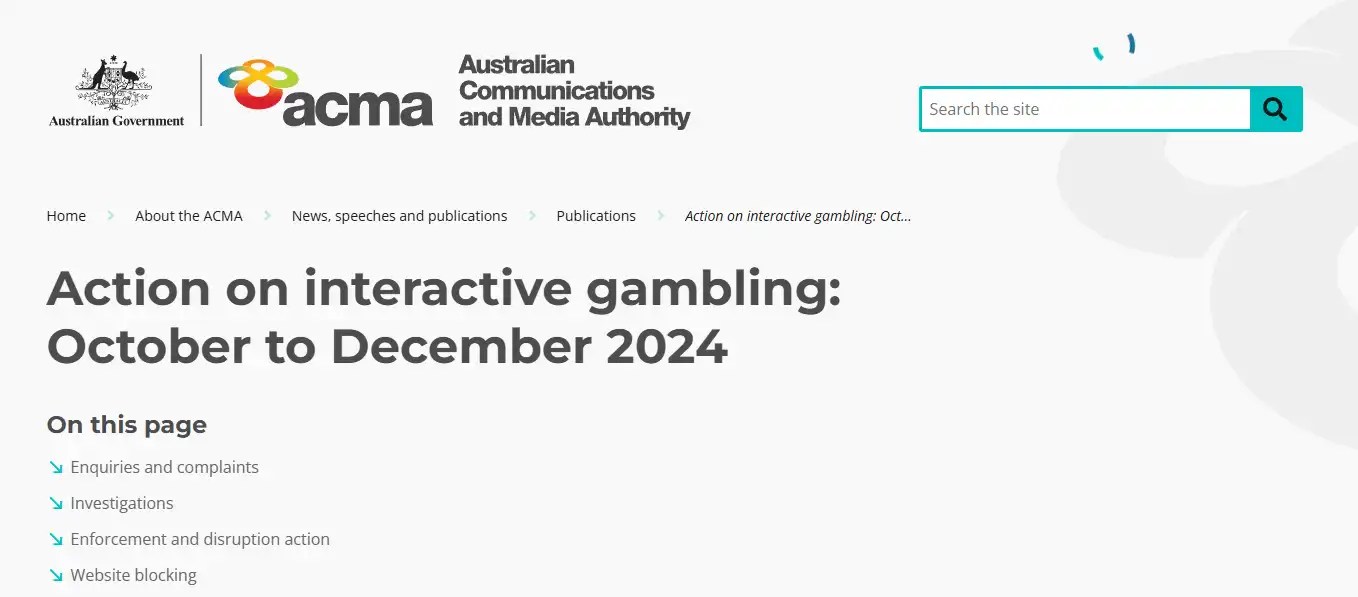
The Australian Communications and Media Authority (ACMA) oversees compliance with federal interactive gambling rules. It can ask internet service providers in Australia to block websites that supply prohibited gambling services or advertise them. Blocking is an enforcement measure, not a guarantee that every offshore site will be inaccessible at every moment. Domains can change, and an accessible page is not evidence of Australian authorisation.
ACMA reports that enforcement actions have resulted in more than 1,455 gambling and affiliate websites being blocked since November 2019. Figures for services that have left the market since enforcement began in 2017 are reported inconsistently: one account puts the number above 210, while another gives a total of over 190.
The practical position for online bonus-buy games in Australia is therefore limited: locally licensed operators cannot lawfully offer online pokies, while offshore services remain subject to ACMA action and sit outside Australian consumer protection. A site appearing in a search or opening in a browser does not settle either point. The feature’s presence in a game and the legality of the service providing it are separate questions; the former cannot answer the latter.
A game tile is an identifier, not a configuration record. It can show the title and artwork for a pokie, but it does not establish which RTP version is loaded or what terms apply to a bonus-buy feature. Two lobby entries with the same name therefore do not, by themselves, confirm that the underlying game settings are identical.
A specialist review describes the operator as selecting the RTP build available in its game offering. That setting is not shown on the lobby tile. The practical check is inside the game: open its information panel and paytable, then locate the stated RTP and the rules relevant to the feature. If those details cannot be found or are unclear, the tile cannot fill the gap.
RTP is normally set out in a game’s rules or paytable. It is a theoretical figure, not a description of what a particular session will return. The purpose of checking it is narrower: to identify the stated configuration of the game being presented, rather than relying on a title, thumbnail or general description. A displayed percentage should be read as information about that build, not a promise about the result of a spin.
The in-game information panel should identify the game rules and provide access to the paytable. The paytable is where the stated RTP is usually displayed, alongside the game’s symbols, wins and feature explanations. These details belong to the loaded game, so they are more relevant than promotional copy or a lobby label when checking the configuration.
The check should establish that the panel and paytable actually open, that the game title matches the lobby entry, and that an RTP figure is stated. Where a bonus-buy option is present, its own rules should also be visible. The feature’s availability and terms are game-specific; the presence of a general “bonus buy” label elsewhere in a casino does not establish how a particular pokie is configured.
This matters for searches such as “buy bonus casino” or “online casino bonus buy”: those phrases describe a broad feature, not a single common setting. A casino may offer games with different rules, and the title alone does not identify the relevant build. Nor does the existence of a purchase option establish that it appears in every version of a game. The game’s own information is the place to verify what is actually presented.
Before wagering, the useful record is the information shown in the game itself: its stated RTP, rules and feature terms. A lobby description may be brief, and a game tile may be shared across different configurations. Neither should be treated as a substitute for the in-game panel. If the displayed details differ from a description elsewhere, the discrepancy is a reason to pause rather than assume that the more favourable wording controls.
The check is also distinct from assessing whether a game is suitable or whether a feature represents value. An RTP figure does not price a bonus entry, and a bonus-buy description does not confirm the RTP build. Those are separate pieces of information. For a game offering a buy-in bonus, the cost and the conditions should be read from its rules; the RTP should be read from the paytable. Combining them into one headline obscures what each figure or term actually means.
A careful reading does not require interpreting a lobby’s design or inferring settings from the game’s name. It requires finding the panel and reading the relevant text. If the RTP is absent, the feature rules are inaccessible, or the information is inconsistent, the configuration has not been adequately established. The absence of a clear display is not evidence that the game uses a particular version.
This approach applies whether a game is being described as a bonus-buy pokie, a slot with a purchasable feature, or a casino game with a bonus entry. The wording can vary; the verification point remains the same. The in-game information panel and paytable show the details associated with the loaded game, while the lobby tile merely helps identify it. Before any wagering, the game-level information—not the label—is the relevant basis for checking the configuration.
A bonus-buy option is a game-specific feature, not a standard part of every pokie. The title, theme or presence of a free-spins round does not establish that the round can also be entered by paying for it. That condition has to be confirmed in the information for the individual game.
The distinction matters because two games can both have bonus rounds while offering different ways to reach them. A round triggered by symbols during ordinary play does not, by itself, mean there is a paid entry option. Nor does a general description of bonus features confirm that the particular version available in a casino includes one. A list of games labelled as bonus-buy titles is therefore incomplete unless its claims match the game configuration actually shown.
Game information should be checked for an explicit description of a purchase or paid-entry feature. If the rules describe only symbol-based triggers, that is not evidence of a buy option. If the feature is described, its displayed terms should be read as part of that specific game rather than assumed to apply across other pokies. The feature’s name alone is not enough to establish its conditions.
Sweet Bonanza illustrates why the two mechanisms should not be conflated. A specialist review describes four or more scatters as the trigger for 10 free spins in that game. That is a description of a scatter-awarded round; it does not establish that a paid route into the round is available in every version. The game’s bonus-round rules and any separate purchase feature need to be treated as distinct information.
This also answers the broader question of which slot games allow a bonus to be bought: only titles whose own information confirms that option. There is no basis for treating the feature as universal, or for inferring it from a game’s popularity. The relevant evidence is the game’s rules and displayed feature terms, not a generic description of casino games.
The same care applies when a game appears in more than one casino lobby. A tile or short catalogue description may identify the title without setting out its full mechanics. The detailed game information is the more relevant place to establish whether a bonus-buy option is present and what the game says about it. Where no such option is described, it should not be presumed.
A paid-entry label also does not say anything, on its own, about the value of a resulting round. It identifies a way of accessing a feature, not a prediction of what that feature will return. The available description should be read for what it states, without treating the word “bonus” as a measure of likely outcome.
In practical terms, “can this bonus be bought?” is answered title by title and version by version. A general list can serve only as a starting point; the individual game’s information determines whether the option is actually specified. If the rules do not confirm it, the feature should be regarded as unverified rather than assumed.
Australian-licensed operators cannot offer online pokies, but individuals are not penalised for playing at offshore sites. Sweet Bonanza is available to Australian players through offshore-licensed casinos, which sit outside Australian consumer protection.
Sweet Bonanza typically has an RTP of 96.51%, although the figure can differ between versions. Check the game’s rules or paytable for the RTP of the version you are playing.
RTP is calculated statistically across a very large number of spins, often millions, to estimate the game’s long-run return relative to the stakes. Each spin is a separate random event, so RTP does not predict the result of an individual spin.
Created by the ”SpinsUP Casino” editorial team.