Australian mobile wallet use does not establish which casinos accept Apple Pay or what their deposit and withdrawal terms allow.

Apple Pay is widely used in Australia: mobile wallets, including Apple Pay and Google Pay, are accepted across almost all of the country. That broad familiarity describes the payment environment, not the cashier rules of any particular online service. A wallet’s presence in everyday commerce does not establish that a specific online casino accepts it.
These are separate claims. One concerns how commonly people can use a mobile wallet across Australian businesses. The other concerns whether a particular operator offers Apple Pay as a payment option to a particular customer. The first cannot prove the second. A general statement that Apple Pay is common in Australia therefore does not establish that an Australian online casino accepts Apple Pay, or that a particular casino can process a payment made with it.
The distinction matters because a payment method is not a universal instruction to every merchant. Recognition of a wallet says nothing by itself about whether an individual service has enabled it, displays it in its cashier, or makes it available to a customer. Those details belong to the service-specific payment arrangement. General familiarity with Apple Pay cannot fill in those gaps.
Apple Pay availability can vary by casino and may depend on your location, so check the payment options shown at the casino before signing up. The details below highlight the information available for each operator without assuming Apple Pay is supported.
Bizzo Casino
Bizzo Casino is listed with a Curacao Gaming Control Board license held by TechSolutions Group N.V.
Vegaz Casino
Vegaz Casino is listed under Curacao OGL/2024/1335/0780. Its minimum deposit is EUR 20.
Neospin
Neospin is listed with Curacao Gaming Control Board OGL/2023/176/0095, held by Hollycorn N.V.
Ricky Casino
Ricky Casino lists a minimum deposit of A$20, or A$30 to qualify for the bonus. Payouts are listed as under an hour for crypto and 1–3 business days for PayID.
7Bit Casino
7Bit Casino is listed as operated by Dama N.V. under a Curacao license.
Kingmaker
Kingmaker lists a minimum deposit of A$30. Its stated payout times are about 90 minutes for crypto and 1–5 days for fiat.
WinSpirit Casino
WinSpirit Casino is listed under Curacao eGaming OGL/2024/923/0383, issued by Antillephone N.V. Its minimum deposit is A$30.
Playfina Casino
Playfina Casino is listed as operating under Curacao eGaming through Hollycorn N.V. since 2017. Its minimum deposit is A$20–30, depending on the offer.
Golden Pokies
Golden Pokies is listed with a Curacao license.
DragonSlots Casino
DragonSlots Casino is listed under the Curacao Gaming Authority, with Jumpman Gaming Ltd as operator.
The same applies to wording such as “mobile casino” or “online pokies” paired with Apple Pay. Those phrases may describe the device used to access a site or the payment method someone is looking for, but neither establishes acceptance. A site being accessible on a phone does not demonstrate that its cashier offers Apple Pay. Nor does the widespread use of mobile wallets in Australia verify a payment route for online casino activity.
A useful way to read an acceptance claim is to keep its scope narrow. “Apple Pay is widely accepted in Australia” is a statement about mobile-wallet use across the market. “This named service accepts Apple Pay for this transaction” is a specific claim about an operator and a payment route. One should not be substituted for the other. Without that distinction, broad market familiarity can make a site-level claim sound more certain than it is.
The word “Australian” can add further ambiguity. It may refer to the location of the customer, the intended market for a service, or simply the wording used in a description. None of those meanings, on its own, confirms that Apple Pay is available in a particular cashier. A country-level label is not a payment-method confirmation.
This is why a general claim about Australian mobile-wallet acceptance has limited value when assessing a specific online casino. It establishes that Apple Pay is a familiar payment tool in the country; it does not establish a list of casinos that accept it, and it does not confirm any named operator or route. A broad fact remains broad, even when placed beside a more specific claim.
The practical distinction is straightforward: mobile-wallet acceptance in Australia is not the same as online-casino acceptance. Any statement about a particular site needs to stand on its own terms rather than borrow certainty from the wallet’s popularity elsewhere. Until those two levels are kept separate, “Apple Pay is common” risks being read as “Apple Pay is available here”—and that is a different claim.
An Apple Pay deposit cannot be priced from the wallet name alone. The amount needed to start a transaction, any charge added to it, and the time taken to process it are separate terms. They depend on the payment arrangement being offered, not on the label “Apple Pay”. Without those terms, there is no sound basis for calculating a final debit or comparing it with another method.
A deposit has at least two relevant amounts: the sum intended for the account and the sum charged to the payment source. If they differ, the gap needs an explanation, such as a stated transaction fee or a currency-conversion charge. If they match, that does not establish that every later transaction will have the same cost. A calculation should use the terms applying to the specific payment, rather than assume that a familiar wallet works like a card or bank-linked service.
The minimum deposit is a separate condition. A proposed amount is not proof that a transaction of that size will be accepted. The payment method may have a minimum set by the operator, and the wallet or underlying card may also have conditions. The usable minimum is the amount that satisfies all applicable requirements. Unless those requirements are available, a low-value deposit cannot be treated as a confirmed option.
Processing time belongs in the cost assessment, but it is not a fee. A transaction that remains pending may tie up funds without changing the stated deposit amount. A claim that a payment is fast does not establish when the account will show the credit, whether additional checks may intervene, or when the card issuer will reflect the transaction. Those are distinct stages; combining them into a single promise obscures the practical result.
The cashier is the relevant place to inspect the transaction terms when a payment option is presented. The amount entered, any displayed charge, the currency, and the status shown before submission should agree with the terms governing the payment. If a charge is disclosed only after an amount is selected, the calculation should use the displayed total rather than the deposit amount alone. If a currency conversion is involved, the conversion rate and any associated charge affect the final cost. No figure should be assumed merely because Apple Pay is familiar from ordinary retail purchases.
That distinction matters in Australia, where consumers are comfortable moving between cards, mobile wallets and bank-linked services such as PayPal. Familiarity with a wallet describes a payment habit; it does not settle the pricing of a particular transaction. Nor does a wallet’s broad acceptance in everyday commerce establish that an online gambling cashier will offer it, or that its terms will match those of a physical shop. The accounting question remains specific: what amount is charged, in what currency, under which stated conditions?
A useful comparison therefore separates the terms rather than compressing them into “free” or “instant”. The deposit minimum answers whether the intended amount qualifies. A transaction fee answers whether the charge exceeds the intended deposit. Currency terms determine whether the payment source may record a different amount. Processing information describes when the account is credited, not what the transaction costs. Each item needs its own stated condition; none can be inferred from the presence of an Apple Pay button.
The same discipline applies to a search for an Apple Pay deposit at a casino. A result mentioning the wallet does not, by itself, establish a minimum, an absence of fees, or a processing time. Those details are material because a small unannounced charge can change the total, while an unstated minimum can prevent the intended amount from being accepted. A price comparison that lacks the operative terms is not a calculation; it is a guess with a payment logo attached.
A deposit cost can be confirmed only when the transaction’s applicable terms produce a clear total. The wallet name identifies a route, not the final amount. Until the minimum, charges, currency treatment and processing condition are stated for that route, the only defensible figure is the amount actually disclosed for the transaction—not an estimate derived from general Apple Pay use.
A claim that an online casino accepts Apple Pay is specific to the operator, not to Australia as a whole. Apple Pay is accepted across almost all Australian retail settings, but broad local use does not establish that a particular casino has enabled it, that it appears in the cashier, or that a payment can be completed. A list of sites cannot be built from general familiarity with the wallet.
That distinction matters when a page labels certain websites the “best” Apple Pay options. A ranking implies more than a payment logo: it suggests that the named operators were checked against a consistent standard and that their stated features can be compared. Without confirmed, operator-level information, neither the eligibility of a site nor its relative position can be substantiated. A polished ranking would still be an unsupported ranking.
A reliable assessment would require evidence tied to the specific operator and its current payment arrangements. At minimum, the claim would need to show that Apple Pay is listed as an available method for the relevant jurisdiction, rather than merely being mentioned in general information about mobile wallets. It would also need to distinguish an actual cashier option from a generic statement that the operator accepts digital payments.
The distinction is not cosmetic. A website may refer to a payment brand without offering it to every customer or for every transaction. Availability can depend on the operator’s own arrangements and the payment route presented at the point of use. A general statement about Apple Pay’s reach in Australia answers none of those site-level questions.
There is also a difference between a method being displayed and a claim being independently confirmed. Operator copy can describe intended availability; an up-to-date cashier view can show what is presented in a particular account or location. Those are not interchangeable forms of evidence. A claim that fails to specify what was checked, and when, is difficult to assess on its own terms.
“Best” is not a payment status. It requires a defined basis for comparison, such as verified availability or clearly documented terms. If the underlying acceptance claim is unconfirmed, a score or ranking cannot repair it. It merely adds a second conclusion to the first one.
The same issue applies to descriptions such as “instant” or “top-rated.” Those labels imply additional attributes that cannot be derived from the presence of a wallet name. A site’s payment method does not, by itself, establish how the operator handles a transaction or how the site compares with another. Such claims need separate evidence; they should not be folded into a payment list as though they followed automatically.
Names create a further risk of false certainty. Including an operator in a table or ranked selection can be read as confirmation that Apple Pay is available there now. A disclaimer in small print does not change the practical effect of a confident heading and a named entry. Where the underlying status has not been established, leaving the name out is more accurate than presenting it with a qualification that readers may overlook.
The useful standard is therefore narrow: a site-level statement needs current, specific support for that site. General acceptance of Apple Pay in Australia is relevant background, but it cannot verify an individual casino’s cashier or justify a comparison among operators. Without that distinction, a list may look precise while saying nothing dependable about the sites it names.
“Instant” is a timing claim, not a feature established by naming Apple Pay. A payment logo can indicate a possible payment route, but it does not state how a withdrawal is handled, when processing begins or when funds become available. Those are separate terms. Without a confirmed withdrawal timetable, describing an Apple Pay payout as instant would turn an assumption into a financial claim.
The distinction matters because “instant withdrawal” can refer to different stages. A request might be submitted immediately, reviewed later, approved after checks, and then passed to a payment provider. The time taken at each stage is not necessarily the same. A fast request submission does not establish fast approval, and neither establishes when money reaches an account or card associated with a wallet.
Know Your Customer checks are another part of the process. Online casinos commonly require identity assessment before handling financial transactions. That review may be relevant before a withdrawal is processed, but its existence does not supply a processing estimate. It does not establish that a check is complete, how long a review takes, or whether a particular withdrawal route is available. “KYC required” and “instant payout” are therefore not interchangeable statements.
A headline promising an instant Apple Pay withdrawal leaves key conditions unanswered unless its terms specify the whole sequence. The relevant details would include whether Apple Pay is actually available for withdrawals, what verification must be completed, when the operator treats a request as approved, and how the receiving payment service handles the transfer. A label or promotional phrase cannot replace those conditions. If any stage is conditional, the word “instant” needs a clear definition before it can be used as a meaningful measure of speed.
The same caution applies to claims about an Apple Pay casino payout in Australia. A payment method used for one transaction does not, by itself, establish that the same method can be used to return funds. Nor does a deposit being accepted prove that a later withdrawal will follow the same route. Deposit and withdrawal arrangements are distinct, and the wallet name does not settle either the availability or timing of a payout.
An "instant" process may involve several distinct stages: immediate request submission, later review, approval after checks, and finally the transfer to the payment provider.
A practical comparison therefore needs a stated time period and a stated starting point. “Processed instantly” may describe only the operator’s action, while the user-facing question concerns the arrival of cleared funds. If terms omit that distinction, the claim is incomplete. The difference is not semantic: money awaiting review is not money available to use.
For a real-money payment claim, the useful evidence is the operator’s current cashier information and withdrawal terms, read together with any verification requirements. The wording should identify Apple Pay as a withdrawal option and explain the applicable processing stages. If those details are not explicit, no reliable instant-withdrawal conclusion follows. A wallet logo is not a service-level commitment, and a speed adjective is not a timetable.
Accordingly, “instant Apple Pay withdrawal” should be treated as a claim requiring precise terms, not as an outcome guaranteed by the payment brand. That requirement says nothing about the duration of an Apple Pay withdrawal. Until the payment route and its timing conditions are stated clearly, the speed remains unmeasured—not instant by default.
The legal issue behind claims about Apple Pay at an offshore casino is separate from the wallet itself. The Interactive Gambling Act 2001 makes it unlawful for operators to provide online casino games to people in Australia. That prohibition covers the operator’s conduct; it does not explicitly make an Australian player’s use of an offshore site a criminal offence.
The distinction matters. A payment option, including Apple Pay, does not alter the legal status of the service being offered. Nor does an operator’s location or an overseas licence change the Act’s application to online casino games provided to people physically in Australia. A casino site may describe a payment route, but that description is not a statement that the underlying service is lawful in Australia.
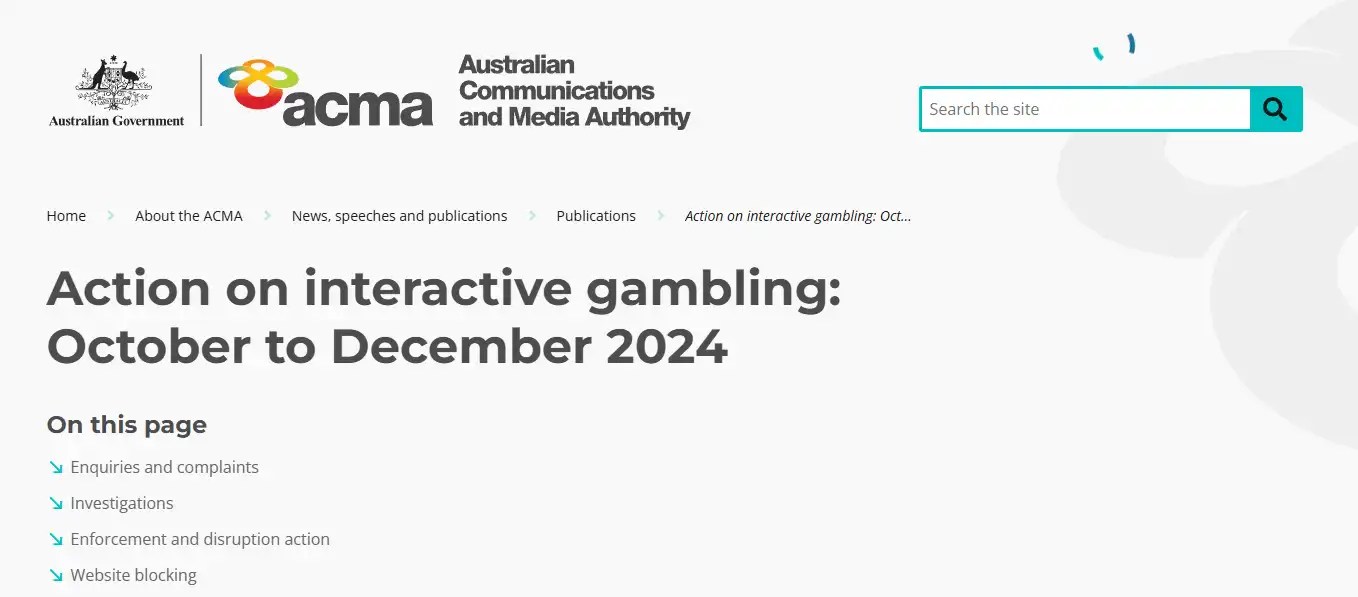
Enforcement sits with the Australian Communications and Media Authority, commonly called ACMA. The authority administers enforcement of the Interactive Gambling Act. The statutory focus is on operators that provide prohibited services to Australians, rather than an explicit criminal prohibition on players who access offshore sites. Those are different legal positions and should not be collapsed into one.
There is also a consumer-protection consequence. Australian consumer law does not protect players using offshore casinos. If a dispute concerns an account, a transaction or winnings, an offshore operator may not be subject to the Australian consumer protections available in dealings with Australian businesses. A payment method cannot supply those protections or serve as evidence that they apply.
For that reason, the phrase “casino that accepts Apple Pay in Australia” can imply more than it establishes. It may describe a claimed payment facility, but it does not establish that the casino is authorised to offer online gambling to Australians, that the service complies with Australian law, or that local consumer protections cover the player. Payment acceptance and legal permission are separate questions.
The practical assessment is therefore not based on whether Apple Pay appears among the cashier options. The relevant legal boundary is that operators must not provide online casino games to people in Australia, while ACMA is the regulator responsible for enforcing that boundary. The Act does not explicitly criminalise players for using offshore sites, but that does not make offshore gambling an Australian consumer-protected service. A wallet label is a payment detail, not a legal safeguard.
A payment option and a game catalogue describe different parts of a service. Apple Pay being available as a mobile wallet in Australia says nothing by itself about which games a particular operator offers. Nor does a game appearing in a catalogue establish that Apple Pay can be used to fund activity associated with it.
The distinction matters because payment acceptance is ordinarily handled at the account or cashier level, while game access is determined separately. A cashier may show a payment method without proving that every game supports it as a distinct payment route. Equally, a title may be listed without providing evidence about how an account can be funded. Treating either detail as proof of the other turns two separate conditions into one unsupported claim.
The broader Australian picture is clear: mobile wallets, including Apple Pay and Google Pay, are accepted almost everywhere. That describes everyday payment availability across the country. It does not establish acceptance by an online casino, the contents of an operator’s catalogue, or compatibility between a wallet and an individual game. A familiar wallet name is not a game specification.
Any claim linking a particular game to Apple Pay would therefore need to identify what is actually being asserted. It could refer to the wallet being accepted for an account deposit, to a game being accessible through a service, or to a payment mechanism built into the game itself. Those are not interchangeable. Without clear terms addressing the relevant service and transaction, the phrase “Apple Pay games” is too imprecise to support a practical conclusion.
The same separation applies to mobile access. A site or service being usable on a mobile device does not prove that Apple Pay is accepted there, and wallet support does not establish that a particular game is available on mobile. Device compatibility, payment acceptance and game access are separate conditions; one cannot be calculated from another.
The reliable conclusion is narrow. Apple Pay’s broad acceptance as a mobile wallet in Australia does not verify any casino’s game offering or any game-specific payment arrangement. Claims about games and payment should be assessed as separate statements, each requiring its own evidence. A wallet label can describe a payment method; it cannot fill in the missing terms of a game or service.
Australian payment habits span several familiar options. Contactless credit and debit cards are accepted across nearly all parts of the country, and mobile wallets such as Apple Pay and Google Pay are similarly widespread. Consumers are also accustomed to moving between cards, wallets and services connected to bank accounts, including PayPal.
That flexibility describes how people pay across the broader market; it does not establish what a particular online service can process. An Australian casino using Apple Pay may sound plausible against a backdrop where the wallet is common, but familiarity with Apple Pay at shops or in other settings does not show that an online casino cashier offers it. The same applies to a claim that a casino accepts cards: broad card use nationally does not confirm the payment options of any individual operator.
The practical distinction is between a payment method being established in Australia and a specific merchant making it available. A wallet can be widely used without appearing in every online checkout. Consumers’ comfort with switching among cards, mobile wallets and bank-linked services reflects choice across the market, not a guarantee that those options are interchangeable at a given business.
Accordingly, general payment habits cannot support a dependable list of Australian casinos with Apple Pay. They provide context for why the method may be familiar, but not evidence of casino availability. Nor does the popularity of a payment option change the legal status of online casino services: Australian consumer law does not protect people who use offshore casinos. Payment convenience is not a substitute for that protection.
The useful market-level observation is narrow. Australians commonly encounter contactless cards and mobile wallets, and can also use services linked to their banks. Those habits explain why Apple Pay is recognisable as a payment brand. They do not settle whether a particular casino accepts it, whether the option is available to Australian customers, or what terms would apply. Those are separate questions about the service itself, not conclusions that can be drawn from everyday payment behaviour.
Whether winnings can be returned through Apple Pay is a separate matter from whether a payment method appears as an option for deposits. A casino withdrawal by Apple Pay would require the operator to support that route for outgoing payments, but the wallet label alone does not establish that it does.
That distinction matters when assessing claims about an online casino with Apple Pay withdrawals. A payment option shown in a cashier may relate only to money going into an account. It does not, by itself, show that winnings can be sent back through the same method. The terms for withdrawals need to state the available route; a general mention of Apple Pay is not enough to establish it.
Financial transactions can also be subject to identity checks. Online casinos commonly require customers to complete a Know Your Customer review before carrying out financial activity. That review is a verification condition, not a timetable: it gives no basis for estimating how long a withdrawal will take, or for describing one as instant.
As a result, questions about Apple Pay withdrawal at an online casino have two distinct parts: whether the operator permits the wallet for payouts, and what process applies once a withdrawal is requested. Neither should be inferred from the other. A casino that accepts a wallet for deposits may have different rules for withdrawals, while a general verification requirement says nothing about which payout methods are available.
The same caution applies to claims about Apple Pay withdrawals for pokies in Australia. The wallet’s broad use in everyday payments does not confirm that any particular casino offers it for returning winnings. Without explicit withdrawal terms, the practical answer is unknown: the route and its processing time cannot be stated as confirmed.
A general Apple Pay reference does not establish that a casino accepts it, and it says even less about payment support for a particular game. The distinction matters when a page links a wallet logo with a claim about slots or pokies: the logo may refer to a payment option at account level, not a feature attached to an individual game.
Apple Pay and Google Pay are accepted almost everywhere in Australia. That describes everyday payment habits, not the cashier arrangements of an online casino or the terms attached to any game. A broad statement about mobile wallets therefore cannot substantiate a list of casinos, or a claim that their games can be funded through Apple Pay.
The evidence needed for a game-specific statement would have to connect the payment route to the named game and explain what the claim means. A deposit made through a casino cashier is not, by itself, proof that a particular game accepts a wallet directly. Nor does a casino-level payment reference show that every game on its platform has the same payment conditions. Without that connection, “Apple Pay supported” is too broad to answer a question about a particular game.
The same caution applies to lists assembled from wallet mentions. A list can appear precise while leaving the central condition unresolved: whether Apple Pay is accepted by the casino, and what the mention actually covers. The distinction is not cosmetic; it separates a general payment label from a substantiated game-level claim.
Accordingly, Australian acceptance of mobile wallets should not be treated as evidence that any casino game supports Apple Pay. A claim about a particular game requires information specific to that game and its payment terms. A wallet mention alone supplies neither.
An Apple Pay option and a casino promotion are separate terms. The presence of one does not establish whether a bonus exists, who qualifies, how its value is calculated or what conditions apply. A payment logo is not a bonus rule.
That distinction matters for any offer described as an Apple Pay bonus. Eligibility could depend on conditions set out in the promotion itself; the wallet name alone cannot confirm them. Nor does the ability to pay by Apple Pay establish that a deposit made that way qualifies for an offer. The same applies to a casino bonus associated with Apple Pay: its label, if used, would not settle the offer’s value or conditions.
Australian consumers are comfortable switching between cards, mobile wallets and bank-linked services such as PayPal. That flexibility describes payment habits, not promotion eligibility. It cannot be used to infer that a particular wallet receives a special offer, or that a promotion applies across payment methods.
For a transaction assessment, the relevant distinction is between payment acceptance and the written promotion conditions. Any claim about eligibility, value or restrictions would need to be stated in those conditions. Without specific terms, the cost or benefit of an Apple Pay-related offer cannot be calculated. Treating a wallet label as evidence of a bonus would turn an unanswered condition into an assumed return—an accounting method with no useful balance sheet.
Jackpot City Casino, Spin Palace, Ruby Fortune, Ignition Casino, Joe Fortune and PlayAmo are among the operators listed as accepting Amex deposits for Australian players.
Check the casino cashier for American Express as a deposit option. If it is offered, select it, enter the card details and deposit amount in AUD, then review the displayed terms before submitting.
Some casinos allow Amex withdrawals, but not all do, and a withdrawal generally requires a previous Amex deposit. Withdrawals can take up to five days to clear, and fees may apply.
Amex casino deposits are processed instantly. This does not mean withdrawals are instant; they can take up to five days to clear.
Yes, some Australian online casinos accept Amex deposits, including Jackpot City Casino, Spin Palace, Ruby Fortune, Ignition Casino, Joe Fortune and PlayAmo. Acceptance is not universal, and an issuer may block gambling transactions.
Amex deposits typically have no fee, but a casino may add a 1.5% surcharge, and Amex cards incur a 3% currency conversion fee. Withdrawal fees may also apply.
Amex casino deposits are processed instantly.
Prepared by the SpinsUP Casino editorial staff.