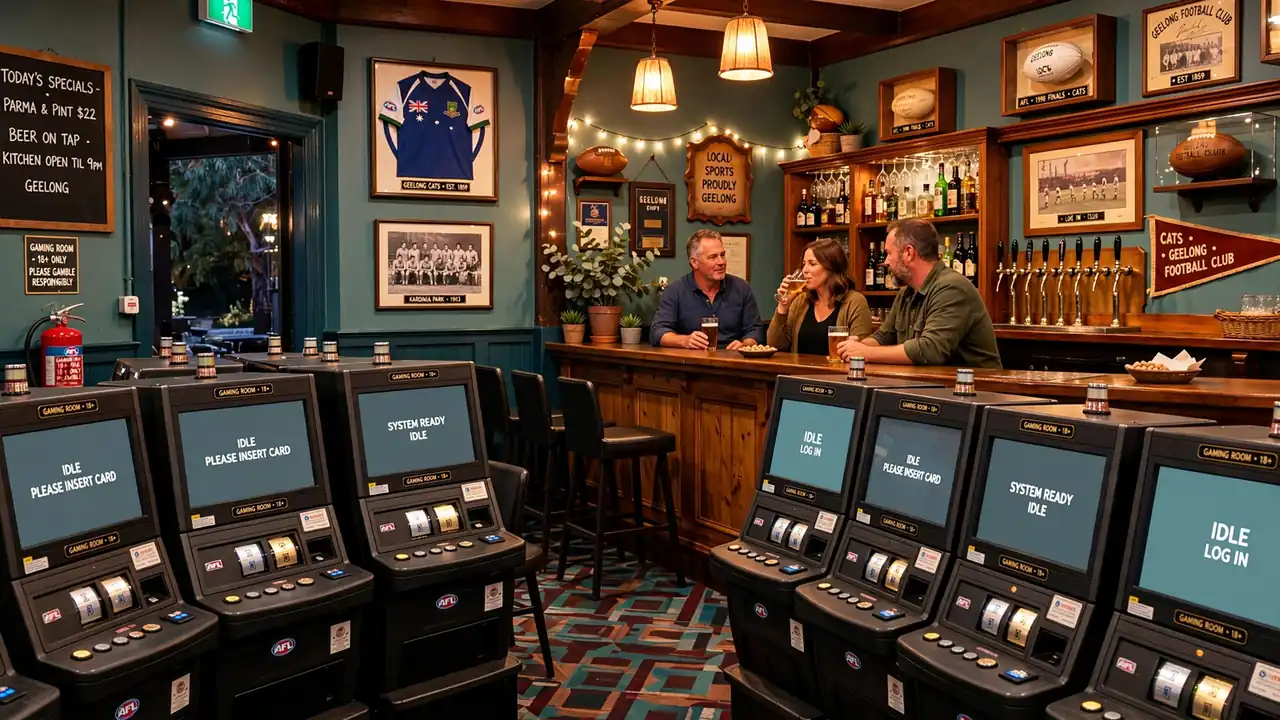
Australian law, payment limits, verification and bonus conditions shape the risks of real-money play on offshore casino sites.

The legal position of real-money online pokies in Australia rests on a distinction between the company providing the service and the person using it. Under the Interactive Gambling Act 2001, offering online casino games, including pokies, to people in Australia is prohibited unless the operator holds a domestic licence. No Australian licences for online casinos have been issued. There is therefore no Australian-licensed online casino.
The Act targets operators, not individual players. Its prohibition on providing the service does not make an Australian player liable for using an offshore site that accepts them. That distinction is important, but it does not convert an offshore casino into a locally regulated service or give a player the protections available through an Australian licensing system.
For someone searching for online pokies in Australia for real money, the practical arrangement is consequently different from a domestic gambling market. Offshore operators may accept Australian customers, but they do so without an Australian online-casino licence. A site’s availability to an Australian user is not evidence that it is authorised to offer the service here. Nor does a foreign licence, if an operator claims to hold one, amount to an Australian licence.
Choosing an online pokies site for real money in Australia calls for a close look at what is actually disclosed about licensing, deposits and payouts. Use these details as a starting point when deciding which options merit further checks.
Bizzo Casino
Bizzo Casino is listed with a Curacao Gaming Control Board license held by TechSolutions Group N.V.
Vegaz Casino
Vegaz Casino lists Curacao license OGL/2024/1335/0780. Its minimum deposit is EUR 20.
Neospin
Neospin lists Curacao Gaming Control Board license OGL/2023/176/0095, held by Hollycorn N.V.
Ricky Casino
Ricky Casino lists crypto payouts in under an hour and PayID payouts in 1–3 business days. The minimum deposit is A$20, or A$30 to qualify for the bonus.
7Bit Casino
7Bit Casino is operated by Dama N.V. and lists a Curacao license.
Kingmaker
Kingmaker lists crypto payouts at around 90 minutes and fiat payouts in 1–5 days. Its minimum deposit is A$30.
WinSpirit Casino
WinSpirit Casino lists Curacao eGaming license OGL/2024/923/0383, held by Antillephone N.V. Its minimum deposit is A$30.
Playfina Casino
Playfina Casino lists a Curacao eGaming license held by Hollycorn N.V. since 2017. Its minimum deposit is A$20–30, depending on the offer.
Golden Pokies
Golden Pokies lists a Curacao license; no other details were provided.
DragonSlots Casino
DragonSlots Casino lists a Curacao Gaming Authority license, with Jumpman Gaming Ltd named as the license holder.
The lack of domestic licensing has a direct consequence if a dispute arises. If an offshore casino refuses to pay winnings, Australian players have no legal recourse in Australia to compel payment. The gap is not a technicality: the operator is outside the domestic licensing framework, and there is no Australian online-casino regulator that can resolve the matter as it would for a locally licensed provider. A displayed balance and a claimed entitlement to winnings are not the same as an enforceable domestic remedy.
The Australian Communications and Media Authority (ACMA) is the primary domestic regulator responsible for enforcing the Interactive Gambling Act. It can act against prohibited services, including by blocking access to illegal offshore gambling sites. Internet service providers are required to comply with ACMA’s blocklist. Blocking is a regulatory measure aimed at limiting access; it does not establish that every offshore site is blocked, nor does a site remaining accessible demonstrate that its operation is lawful in Australia.
These two facts can coexist: the law prohibits operators from providing online casino services to people in Australia, while the law does not impose liability on individual players for using an offshore site that accepts them. The player-facing risk is therefore not a domestic prosecution under the Act, but the absence of local licensing and the lack of Australian legal recourse if the offshore operator fails to honour a claim. Treating operator legality and player liability as interchangeable would obscure the point that matters most when money is at stake.
The legal age for gambling in Australia, including online pokies, is 18. Meeting that age requirement does not change the status of an offshore casino or create a domestic avenue for resolving a payment dispute. Age eligibility and operator authorisation are separate questions.
The result is a narrow but consequential position for real-money pokies online: there is no domestic online-casino licensing route, the statutory restriction is directed at providers, and ACMA’s enforcement role includes blocking access to prohibited offshore services. Australians may encounter offshore sites that accept them, but that practical access should not be confused with Australian approval or protection. If winnings are withheld, the absence of local recourse leaves the player without an Australian licensing system to turn to.
PayID is not a separate bank account or a casino balance. It is an alias attached to an account within Australia’s New Payments Platform (NPP). Instead of entering bank account details, a transfer can be addressed to an email address, mobile number or Australian Business Number (ABN) registered for PayID. The alias identifies where the payment is routed; the underlying funds still come from the linked bank account.
The NPP is available through all major Australian banks, and its transfers use end-to-end encryption. Those properties describe the payment infrastructure. They do not describe the business receiving a transfer, the terms under which it accepts funds or the games it provides. A payment rail can be secure in transit while the recipient remains difficult to assess. The distinction matters when PayID appears among the payment options on an offshore gambling site.
To use PayID for a real-money deposit, the player first needs to link a PayID to a bank account. That setup takes place through the relevant bank or financial institution, not by creating a casino account. Once the alias is active, a payment request can direct funds through the NPP using the registered identifier. The account holder should check that the displayed recipient details match the intended destination before authorising a transfer; the alias is a routing detail, not a guarantee about what happens after the money arrives.
A PayID button or instruction establishes only that a site says it can receive funds through that route. It does not establish that the site is licensed, that a pokie is fair, or that its published return information accurately describes the version of the game being offered. Those are separate questions, and the presence of a familiar Australian payment method cannot answer them.
That distinction is particularly important for searches for online pokies that pay real money through PayID. The payment method changes how a deposit is addressed and routed. It does not change the underlying chance-based nature of a pokie, verify the operator or make winnings predictable. Nor does it convert an offshore gambling service into an Australian-licensed one. The payment system and the gambling service are separate layers, even when the site presents them together on one screen.
A specialist review describes PayID as being handled like other qualifying deposit methods on the particular sites it assesses. That is a description of those reviewed sites, not a rule established for every operator or a permanent feature of the market. Payment methods and processing arrangements can change, so the appearance of PayID should not be treated as proof that a transfer will be accepted in every case.
A payment can be technically supported by the NPP and still be stopped by a bank. A specialist review reports that some Australian banks, including members of the Big Four, have at times blocked PayID transfers to gambling merchants they recognise. This is a bank-side decision rather than a failure of the PayID alias itself. The outcome can depend on the bank’s controls and the merchant details associated with the transaction.
A separate specialist review reports a broader increase in blocks by Australian banks and card companies for transactions to known gambling sites. That should be read as a reported development, not as a guarantee that every bank applies the same restriction or that every transfer will be declined. A declined payment also does not establish that the receiving site has acted improperly; the bank may simply have prevented the transaction.
Card payments have their own cost exposure. A specialist review notes that a bank or card issuer may classify a gambling deposit as a cash advance, potentially adding a fee of three to five per cent and charging interest immediately. The treatment depends on the issuer and transaction. A card statement can therefore carry a financing cost that is separate from the amount deposited. This is one reason payment labels alone do not reveal the full cost of moving money.
The useful accounting distinction is straightforward: PayID describes the route, while the bank controls the account funding that route. The recipient’s payment instructions describe where it wants funds sent. None of those details confirms the recipient’s licensing status, game settings or reliability. Calling a deposit option “instant” or placing a PayID logo beside a game does not supply that missing information.
For real-money play, the key point is not whether PayID is familiar or widely supported at the banking level. It is that the alias connects a transfer to a bank account, while the gambling site remains a separate counterparty. The NPP’s role ends at payment infrastructure; it does not assess pokies or resolve disputes about an offshore operator. A PayID listing is therefore a payment detail, not a trust certificate.
The amount shown beside a bonus is not necessarily the amount that can be withdrawn. Wagering requirements determine how much qualifying play must be recorded before bonus funds or associated winnings become cashable. The calculation depends on the terms: the multiplier may apply to the bonus alone or to the deposit and bonus together. Those bases produce different turnover obligations from the same headline offer.
A specialist review uses a 35-times-or-lower wagering requirement as a screening benchmark and describes requirements above 40 times as punishing. These are review criteria, not a universal measure of value: the precise calculation and eligible games still depend on the offer rules. A specialist review’s worked example shows the scale. A $500 bonus at 40 times requires $20,000 in turnover before any winnings can be withdrawn. If a 35-times requirement applies to a $500 deposit plus a $500 bonus, the required turnover is $35,000. The multiplier is therefore not a small-print detail; it sets the amount of play attached to the offer.
The wording must be checked for the calculation base. “Bonus only” and “deposit plus bonus” are materially different terms, even when the displayed multiplier is identical. The rules also determine which games count and whether a contribution rate applies. A balance can appear substantial while remaining subject to conditions that prevent withdrawal. For a real-money session, the relevant figure is not the promotional balance but the amount that remains withdrawable after those terms are met.
Free spins create a separate exposure. A specialist review notes that an offer can cap the winnings eligible for cashout. That cap can make the amount won on the spins different from the amount payable, even where the spins themselves cost nothing. The offer terms need to state whether a cap applies and what happens to any winnings above it. “Free” describes the entry cost, not necessarily the eventual cash value.
Withdrawal limits affect timing as well as amount. A specialist review reports that some casinos set weekly or monthly withdrawal caps of $5,000–$10,000. Under such a cap, a $50,000 jackpot could be paid in instalments over a multi-year period rather than as a single transfer. The practical value of a win therefore depends not only on its recorded amount but also on the payout ceiling and its period of application. A stated win and cash received are not interchangeable accounting entries.
Bonus Turnover Calculation
Determine the base
Identify if the wagering requirement applies to the bonus alone or the combined deposit and bonus.
Apply the multiplier
Multiply the base amount by the wagering requirement (e.g., $500 bonus × 40 = $20,000 turnover).
Compare with actual play
Track total bets made until the required turnover amount is reached before attempting withdrawal.
Identity checks are another condition attached to withdrawal. A specialist review reports that casinos may require verification before the first cashout, including identity documents and proof of address, and in some cases a selfie holding the identity document. These checks can leave a withdrawal pending until the submitted material is accepted. Account details and documents should therefore be consistent, and the requirements should be reviewed before funds are committed. Verification is not a substitute for clear withdrawal terms; it is an additional step that can affect access to winnings.
The order of checks matters. A balance may be subject to wagering conditions, then a cashout cap, then identity and address verification. Each condition answers a different question: whether turnover is complete, how much can be paid in a period, and whether the account holder has been verified. A headline bonus or jackpot figure alone answers none of them. The terms should be assessed as a sequence of conditions, not as a single advertised amount.
Limits can also be set before play begins. Deposit limits, loss limits and session-time limits are responsible-gambling tools, alongside self-exclusion. They do not change the bonus calculation or guarantee a withdrawal; they constrain exposure during play. Their value is in setting boundaries on money or time at risk, rather than improving the terms attached to winnings. A financial review is clearest when the promotional balance, turnover obligation, cashout ceiling and verification requirement are kept separate.
A real-money pokie can produce a win, but no spin provides a reliable forecast of the next one. Each spin is an independent event determined by a Random Number Generator (RNG). The outcome of an earlier spin does not make a later win due, and a run of wins does not establish that another is likely to follow. The same applies after losses: the machine has no memory that turns past results into a prediction.
That independence matters when assessing claims about pokies that win real money. A result seen in one session describes that session, not what another player will experience or what the next session will return. A winning streak is an outcome, not evidence of a pattern that can be relied on. Equally, a long losing stretch does not create a reason to expect the next spin to pay. Treating either sequence as a signal turns randomness into a story; the story does not alter the next RNG event.
RTP, or return to player, is a different measure from a prediction about an individual session. It refers to a game setting, not a promise that a particular player will receive a matching share of their stake. Even where a return percentage is published, it cannot specify the result of a short run of spins or the timing of a win. A player may finish well above or below a stated return. The figure does not function as a balance owed to an account.
There is also a comparison problem: the same pokie may not use the same RTP setting at every casino. A specialist game-review source reports that some providers give casinos a choice of settings for a particular game. In that case, the title alone is not enough to establish which return setting applies. The game’s information at the relevant casino is the material detail; a familiar name or identical appearance does not settle the percentage.
That distinction separates two uncertainties. The RNG governs the outcome of each spin. The selected RTP setting affects the game’s stated return model over the long term. Neither tells a player what a particular sequence will deliver, and an RTP figure cannot remove the randomness of individual spins. Comparing settings may describe one aspect of a game, but it cannot turn play into a forecastable source of income.
Free-play results do not provide a dependable forecast of real-money play either. A series of successful spins in a free mode cannot make a later cash session more likely to win: each spin remains an independent RNG event. The same is true in reverse. Poor free-play results do not establish that a cash session is due to improve.
For anyone evaluating real-money pokies, the financially sound reading is narrow: a win is possible, but its timing and size are not predictable from previous spins. RTP settings can differ between casinos, while the next outcome remains random. Neither a memorable result nor a return percentage changes that basic limit.
“No deposit” describes how an offer is issued, not what can ultimately be withdrawn. A no-deposit bonus or free spins may produce a balance on screen, while the terms still require wagering before cashout or restrict the amount of winnings eligible for withdrawal. The value that matters is therefore not the displayed balance alone, but what remains after the conditions are applied.
A specialist review frames wagering requirements as a turnover multiplier and treats requirements of 35x or less as a more workable benchmark, while describing anything above 40x as punishing. These are that review’s assessments, not a guarantee of what any offer will require. The arithmetic is more useful than the label: a 40x requirement attached to a $500 bonus entails $20,000 in bets before winnings can be withdrawn. That turnover is not a fee paid once; it is the total amount wagered under the stated condition.
The calculation changes if the multiplier applies to the deposit and bonus together. With a $500 deposit and a $500 bonus, a 35x requirement applied to the combined $1,000 balance produces $35,000 in required bets. The multiplier alone does not reveal the full obligation. The terms need to specify which amount is multiplied, which games count toward wagering, and whether the requirement applies to the bonus, winnings, or a combined figure. Without that base, a headline multiplier cannot be translated into a cashout condition.
Free-spin offers can impose a separate limit: a cap on the winnings that may be cashed out. In that case, completing wagering does not necessarily make the entire balance withdrawable. The cap may determine the maximum eligible amount, independently of how much a session appears to have won. A no-deposit offer can therefore have two distinct filters: turnover before withdrawal and a ceiling on the resulting cashout.
The distinction matters for searches for real-money pokies in Australia, including offers associated with PayID. A payment option describes how a deposit may be routed; it does not turn a no-deposit balance into withdrawable cash or remove the offer’s conditions. If no deposit is required, PayID has no role in generating that initial promotional balance. If the offer is tied to a deposit, the promotional terms and payment route remain separate questions.
No-deposit wording is not evidence that an offer is available, that winnings are unrestricted, or that cashout is assured. The relevant figures are the wagering base, the multiplier, and any cap on eligible winnings. If one of those terms is absent or unclear, the advertised balance cannot be treated as a reliable estimate of the amount payable.
A pokie’s title does not, by itself, establish its return percentage. A specialist review reports that some game providers allow casinos to choose between multiple RTP settings for the same game. Where that option is used, the identical pokie can therefore carry different return percentages at different casinos.
For Australian real-money pokies, this makes the game name an incomplete comparison point. Two versions can look and play alike while operating with different settings. Comparing titles without comparing the stated RTP can conceal that difference; comparing RTP figures without confirming they refer to the same game and version can be equally misleading.
RTP is a theoretical return measure, not a promise about the amount returned in an individual session. It also does not show which setting has been selected at a particular casino unless that information is available and tied to the game being offered. A familiar title, or a figure shown elsewhere for that title, is not enough to establish the setting in use.
The practical comparison is therefore specific: match the game, identify the RTP attached to the version offered, and treat the casino’s stated figure as relevant only to that version. If no setting is disclosed, the title alone cannot fill the gap. That is a limit on the comparison, not evidence that the game uses a particular return rate.
This matters when assessing Australian real-money online pokies because the same catalogue entry may not mean the same configured game across different casinos. A comparison of best Australian online pokies for real money cannot be made on titles alone; the available RTP information must also be comparable. No single return percentage can be assumed for every casino offering a given pokie, and a provider’s ability to offer multiple settings does not establish which one any particular casino has selected.
An app icon is a way into an account, not evidence about the account’s security or the conditions attached to it. The label “real-money pokies app” does not establish that an operator is authorised to serve people in Australia, that account records are protected to a particular standard, or that a withdrawal will be approved. No specific app can be treated as safe on the basis of its appearance or availability alone.
Account verification is a separate issue from the way a service is accessed. A specialist review reports that casinos may require identity checks before the first withdrawal. The requested material can include a photograph of an identity document and proof of address; a selfie holding the document may also be requested. These are not merely profile details: they are documents tied to a person and their residence.
The practical point is to understand the verification requirement before money is placed in an account. The operator’s terms should state which documents are accepted, how they are submitted, and what happens if details do not match. A name or address entered inconsistently can leave an account under review when a withdrawal is sought. The exact procedure is operator-specific; an app does not make it uniform.
Security also depends on what happens to submitted information. Before creating an account, the privacy and account terms should be checked for how documents are handled and what access controls are described. A polished interface cannot answer those questions. Nor does an app-store listing, a payment option or a claim of convenient access prove that personal documents will be treated appropriately.
BetStop has a defined limit: it applies to Australian-licensed operators and does not bind offshore sites. As there is no Australian-licensed online casino, a person should not assume that a self-exclusion entry will prevent access to an offshore casino account. That distinction matters more than whether the service is opened through an app or a browser.
For real-money use, the relevant checks are therefore the operator’s stated identity and address requirements, the handling of those documents, and the limits of any account-protection measure. An app is an access format. It is not a substitute for those checks, and it does not resolve the exposure attached to providing identity documents to an offshore service.
A browser can display pokies on a phone without a dedicated app, but changing the access format does not change the financial exposure. A small screen can make balances, rules and session duration less visible; it does not make a stake smaller or a loss easier to recover.
The useful controls are the same ones used elsewhere: deposit limits, loss limits, session time limits and self-exclusion. Each addresses a different point in the spending path. A deposit limit constrains funds entering an account. A loss limit sets a boundary on money lost. A time limit interrupts a session, while self-exclusion is a stronger restriction on access. These controls are only useful if their settings are understood and the operator actually applies them.
Mobile use can blur the boundary between a brief check and a longer session. Notifications, saved browser tabs and quick access may keep a gambling page close at hand. That is a design issue, not a financial advantage. A preset session limit is more concrete than relying on a phone clock or deciding to stop after a win or loss.
Limits should be treated as ceilings, not targets. Raising one after reaching it changes the boundary rather than improving the result. Keeping a separate record of deposits and losses can also make cumulative spending visible when the browser displays only the current session.
BetStop is Australia’s national self-exclusion register, but it applies only to Australian-licensed operators and does not bind offshore sites. There is no Australian-licensed online casino, so BetStop cannot be treated as a control that blocks access to offshore online pokies.
For Australian residents, the browser interface does not alter the legal position or turn a real-money service into a locally licensed one. Nor does mobile access establish anything about a site’s fairness or protections. The practical distinction is simple: the phone changes where the page appears; it does not change the limits, the losses or the scope of a self-exclusion tool.
A recently launched site can look current without offering anything that establishes its reliability. A PayID logo is a payment detail, not evidence that a site is licensed, that its games are fair, or that it discloses the RTP setting used for a pokie. Those are separate questions; a familiar transfer method answers none of them.
The same distinction applies when comparing new real-money pokies sites that accept PayID. Availability of the payment option says only that the site presents it as a deposit route. It does not verify who operates the site or how a game is configured. A specialist review has reported that some Australian banks, including members of the Big Four, sometimes block PayID transfers to gambling merchants they recognise. That account is not a guarantee that a particular transfer will be accepted or declined; bank decisions can vary.
BetStop is not a substitute for checking the limits of an offshore account: it applies to Australian-licensed operators and does not bind offshore sites. A payment option cannot extend its reach.
The practical comparison is therefore narrow. PayID may be present in a cashier, but that fact should not be counted as a trust credential or a measure of game transparency. A newer site does not acquire credibility by offering a payment method that is also used elsewhere. Licensing status, fairness information and RTP disclosure must be assessed independently—and a payment badge supplies no answer to any of them.
A reference to PNG does not, by itself, establish where an operator is licensed, which rules apply, or whether a particular game or payment method is available. Those details depend on the relevant jurisdiction and the operator’s terms; they cannot be inferred from the label alone.
The Australian position is specific to people physically located in Australia. The Interactive Gambling Act 2001 prohibits operators from providing real-money online casino games, including pokies, to customers in Australia. The law targets providers rather than individual players, and the Australian Communications and Media Authority (ACMA) enforces it, including by blocking access to illegal offshore gambling sites. These points explain the Australian framework; they do not describe PNG’s regulatory system.
The same boundary matters for practical decisions. A payment option does not establish that an operator is licensed or that its games have a particular return setting. Nor does a game’s name establish which version or terms apply at a particular site. Those questions require jurisdiction-specific information and the operator’s applicable terms.
For Australian residents, offshore access also does not create an Australian route for recovering winnings if an operator refuses payment. BetStop is limited to Australian-licensed operators and does not bind offshore sites; there is no Australian-licensed online casino. The legal gambling age in Australia is 18.
Accordingly, Australian rules should not be presented as a guide to PNG, and a PNG label should not be treated as proof of local oversight. The useful distinction is between what is established for Australia and what would need to be confirmed under PNG’s own laws and operator arrangements.
Australians are not liable under the Interactive Gambling Act for playing on an offshore site that accepts them, but operators are prohibited from offering online pokies to Australians without a domestic licence, and none have been issued. Offshore sites therefore lack Australian licensing, and players have no legal recourse in Australia if one refuses to pay winnings.
No betting strategy can predict a pokie’s next result: each spin is an independent event determined by a Random Number Generator. If you play, use tools such as deposit, loss and session-time limits to manage your gambling.
Yes, some game providers let casinos choose from multiple RTP settings for a pokie. The same game can therefore have different return percentages at different casinos.
Compare the wagering requirement with the amount you must bet before withdrawing. For example, a $500 bonus at 40x requires $20,000 in bets; if the requirement applies to a $500 deposit plus the $500 bonus at 35x, it requires $35,000 in bets.
Created by the ”SpinsUP Casino” editorial team.