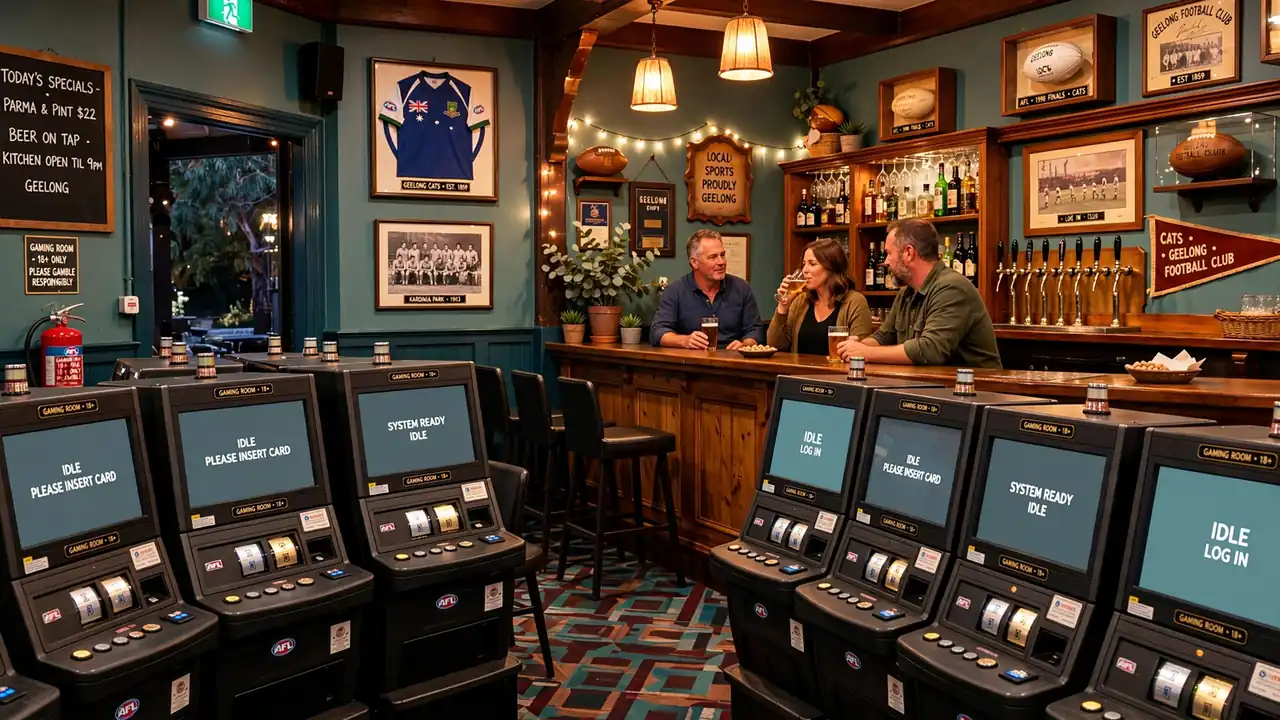
A practical guide to odds, game information, bankroll limits and bonus terms, without treating past spins as clues to future results.

Pokies tips and tricks can help define a session’s rules, but they cannot identify which spin will win. Each poker machine spin is random and independent of the spins before it. A run of losses does not make a win “due”, and a recent win does not make another one more likely. The machine has no memory to consult.
That distinction matters because many familiar claims confuse a decision with an outcome. Choosing when to play, changing bet size, switching machines or waiting for a particular pattern may alter what happens to a player’s balance, but none makes the next result more favourable. Lucky charms and rituals can add personal meaning to play; they do not change the machine’s chances.
The same applies to timing. A machine does not become more generous because it has been quiet, because a session has lasted a certain time, or because someone starts at a supposedly lucky moment. Watching symbols, previous results or other players’ wins cannot reveal the outcome of an independent spin. A pattern in past results is not a reliable signal about the next one.
A good pokies strategy starts with choosing a casino whose terms and practical details you can check before you play. Use this list as a starting point, then review each operator’s current terms and make sure they suit your needs.
Bizzo Casino
Bizzo Casino is listed with a Curaçao Gaming Control Board licence held by TechSolutions Group N.V.
Vegaz Casino
Vegaz Casino lists Curaçao OGL/2024/1335/0780 and a minimum deposit of EUR 20.
Neospin
Neospin lists a Curaçao Gaming Control Board licence, OGL/2023/176/0095, held by Hollycorn N.V.
Ricky Casino
Ricky Casino lists crypto payouts in under an hour and PayID payouts in 1–3 business days. The minimum deposit is A$20, or A$30 to qualify for the bonus.
7Bit Casino
7Bit Casino is listed as a Curaçao-licensed casino operated by Dama N.V.
Kingmaker
Kingmaker lists crypto payouts at around 90 minutes and fiat payouts in 1–5 days. Its minimum deposit is A$30.
WinSpirit Casino
WinSpirit Casino lists Curaçao eGaming licence OGL/2024/923/0383, issued to Antillephone N.V., and a minimum deposit of A$30.
Playfina Casino
Playfina Casino lists a Curaçao eGaming licence held by Hollycorn N.V. since 2017. Its minimum deposit is A$20–30, depending on the offer.
Golden Pokies
Golden Pokies is listed with a Curaçao licence; no further operator details were provided.
DragonSlots Casino
DragonSlots Casino lists a Curaçao Gaming Authority licence held by Jumpman Gaming Ltd.
The useful part of advice about pokies is therefore narrower and more practical. It concerns choices that remain under a player’s control: whether to play, which game to select, what bet size to use, and when to stop. Those choices can shape the pace and cost of a session. They do not turn chance into a forecast. Managing exposure is not the same as improving the odds of a win.
There is also a limit to what any strategy can achieve financially. Every pokies strategy has negative expected value because of the house edge; no system produces positive expected value. A method may change the sequence of bets or the way a session feels, but it cannot remove that underlying disadvantage. Calling a system “disciplined” does not make its outcome profitable in expectation.
This is why tips that promise a reliable route to a win should be treated as claims, not instructions. A strategy built around chasing losses, increasing bets after losing, or repeating a sequence may sound orderly. Its order comes from the player’s decisions, not from control over the machine. If spins remain independent, the sequence cannot force a favourable result.
A sound way to assess any tip is to ask what it actually changes. If it changes a controllable choice, such as the bet size or the decision to stop, it may help organise play. If it claims to predict or influence a spin, it has no effect on the random result. The boundary is simple: decisions can be managed; outcomes cannot be read in advance.
A useful way to assess claims about tips to win pokies is to separate a machine’s long-run maths from the result of a particular session. RTP describes the share of all money bet that a pokie is designed to return across millions of spins. It is a statistical measure over a very large number of plays, not a promise that a particular player will receive that share back.
For gaming machines, the required lifetime return sits between 85% and 92% of the money bet. The corresponding portion not returned is the house edge: across that range, it is 8% to 15% of turnover in the long-run calculation. This is not a deduction taken evenly from every spin. One spin may return nothing; another may produce a payout. The percentage describes the aggregate pattern over extensive play, not a schedule of individual outcomes.
The expected-loss calculation makes the distinction clearer:
Expected loss = bet × spins × (1 − RTP).
Here, the bet is the amount placed on each spin, spins is the number played, and RTP is written as a decimal in the calculation. The expression estimates the loss implied by the stated return over a sufficiently large body of play. It does not predict the exact amount lost in a short session, and it does not set a limit on how much a session can win or lose.
For a fixed bet size and number of spins, a higher RTP produces a smaller theoretical expected loss. That is a comparison of long-run cost, not a method for turning a negative expectation into a positive one. At the stated return range, the machine is not expected to pay back all the money wagered over its lifetime. A strategy that changes the sequence of bets cannot remove that underlying margin.
A short run of spins is too small to behave like a neat sample of the lifetime return. Results can cluster: a session may include payouts close together, or long stretches without a significant return. Either pattern can occur without changing the machine’s theoretical RTP. A result that looks unusually generous does not establish that the next spin is more likely to lose; a poor run does not make a payout due.
This is why a displayed RTP should not be read as a forecast for a single visit. If a game’s theoretical return is expressed as a percentage, it says what the model returns in aggregate across a vast number of spins. It does not mean that each individual balance will be reduced by the complementary percentage, nor that a player will recover a fixed share after a chosen number of spins. Short-session variance can be large relative to the average implied by the formula.
The same distinction applies to large-prize claims. On a $1 poker machine, the stated odds for a typical $5,000 prize are 9,700,000 to 1. That figure gives scale to the rarity of that particular payout; it does not say that a player will win after making a corresponding number of spins. Nor does it describe the chance of receiving any smaller payout. A headline prize is one outcome within a much broader paytable, and its odds should not be confused with the game’s overall RTP.
The formula is useful for comparing the expected cost of different amounts of play when the relevant RTP is known. It can show why total turnover matters: more spins at the same bet size raise the theoretical expected loss, while a higher RTP lowers it. These are arithmetic relationships, not winning tricks. The calculation cannot identify which spin will pay, establish when a prize is coming, or tell whether a specific session will finish ahead.
Claims about “winning systems” often blur two separate questions: whether a player can control the outcome of a spin, and whether the terms of play change the long-run expectation. The RTP calculation addresses the second question only in aggregate. It offers no signal about the first. A lucky result may happen, but it does not validate a technique; a loss does not prove that a better timing pattern was missed.
The practical value of the maths is therefore narrower than many tips suggest. RTP and expected loss describe the average economics of play at scale. Prize odds show how unlikely a named outcome can be. Neither figure provides a short-session forecast. Treating them as promises would turn statistical descriptions into claims they cannot support.
RTP is a comparison measure, not a forecast. It describes the share of total bets a pokie is designed to return across millions of spins. A higher displayed RTP indicates a higher theoretical return over that long run; it does not set the result of a particular spin or guarantee that a short run will resemble the stated percentage.
For a like-for-like comparison, check the RTP shown for each game and look for pokies with an RTP above 96%. That threshold is a screening point, not a promise of value or a dividing line between winning and losing games. A higher figure can distinguish one game’s theoretical return from another’s, but it cannot remove the house edge or establish what any individual session will produce.
The figure must be checked on the game’s own information screen. A title may be offered in versions with different settings, so a value quoted in a general description may not identify the configuration currently being played. The information screen is the relevant place to confirm the displayed RTP for that version. If the value is absent or unclear, the comparison has no reliable number to use.
RTP and volatility describe different features. RTP concerns the long-run proportion returned; volatility describes how results are distributed across play. A game with lower volatility may produce smaller wins more often, while a higher-volatility game may have less frequent but larger wins. Those descriptions do not indicate which game will pay during a particular session, and volatility does not override the displayed RTP. Treating a volatile game as “due” for a large result confuses a possible pattern of payouts with a prediction.
A specialist review reported an analysis of 6,847 sessions in which the median RTP was 96.2% compared with declared values. That is a reported result from that review, not a universal benchmark for every pokie or platform. The scale of the sample does not turn observed session data into a promise about a different game, configuration or future run. Its useful point is narrower: declared RTP and measured results are concepts that need to be distinguished, and a short record cannot establish what a particular player should expect.
A sound comparison therefore records the displayed RTP and the game version, then considers volatility separately. Comparing figures from different versions, or treating a volatility label as a substitute for RTP, produces a misleading ranking. Likewise, a game’s presentation, theme or reputation supplies no mathematical evidence about its return.
The practical limit of pokies tips and tricks is that they can improve the quality of a comparison, not alter the game’s settings or forecast a result. The information screen provides a stated theoretical measure; volatility supplies context about the shape of possible outcomes. Neither turns a higher RTP into a winning system.
A bankroll limit sets the amount available for play; it does not set a target that must be spent. A deposit limit can cap how much is transferred to an account over a chosen period, while a session timer can mark when a playing period ends. These controls address separate risks: a deposit cap constrains access to funds, and a timer interrupts a session before its duration expands by default.
Neither control alters the outcome of a spin. Their value is administrative: they make a decision about money or time before play begins, rather than leaving it to a moment when losses or a run of small wins may affect judgement. A limit is useful only if it is set at an amount that can be lost without affecting essential expenses. Treating it as a sum that should be recovered or played through turns a control into another target.
Session duration is not a measure of winning potential. A longer session means more opportunities for outcomes to occur, but it does not make a favourable result more likely on any particular spin. Nor does ending early mean that the remaining balance has been protected by a better method. The practical distinction is between controlling exposure and trying to forecast a result: limits can do the former, not the latter.
A limited session budget may last longer on a high-RTP, low-volatility game because smaller wins occur more frequently. That can extend play time, but it does not convert the budget into a safer investment or create a better chance of finishing ahead. More frequent small returns are still part of the game’s overall payout structure; they are not a promise that losses will be offset. Session length is a description of how long funds remain in play, not a measure of improved odds.
Mobile play can make pace harder to notice. Swiping through a game and moving between spins with little friction can raise the number of spins in a session. A specialist review has noted that this faster mobile pace can increase the rate at which theoretical expected loss accumulates. The point is about speed, not a different outcome per spin: when more bets are placed in less time, the expected cost of play accrues faster. A timer can interrupt that momentum; a deposit limit cannot slow spins once funds are already available.
A workable control plan therefore separates the amount, the duration and the pace. The deposit limit defines the funding boundary. The timer defines when the session stops. Pauses between spins reduce automatic continuation, particularly on a mobile interface where the next action is close at hand. These measures do not guarantee that a session ends with money remaining. They make the boundaries explicit before the result is known.
Claims about pokies winning tips often blur this distinction, presenting longer play or a particular pace as a way to improve results. Neither follows from bankroll controls. A limit can prevent spending beyond a chosen boundary; a timer can prevent an open-ended session. Both can reduce uncontrolled exposure, but neither changes the game’s mathematics.
In Australia, “pokies” is the everyday term for slot machines. The word appears in conversation, news coverage and descriptions of gambling, but it does not change the legal category of the activity. A game remains an online casino-style service whether it is labelled a pokie, slot or something else.
The distinction that matters is where the person is physically located and who is providing the service. Under the Interactive Gambling Act 2001, operators cannot legally provide real-money online casino games to people in Australia. The prohibition covers slots as well as online poker and table games such as blackjack and roulette. An offshore business does not avoid that rule simply because it holds a licence issued elsewhere.
A licence from an overseas jurisdiction, such as Malta, Gibraltar or Curaçao, is not an Australian authorisation to offer online casino games to people in Australia. It may describe the provider’s position under that jurisdiction’s rules; it does not override Australian law. The relevant question is not merely whether a site displays a licence badge, but whether the service may lawfully be supplied to someone physically in Australia. For real-money online pokies, the Act prohibits the operator from providing that service.
This distinction also prevents a common misunderstanding: the Act’s prohibition on operators should not be recast as a criminal offence committed by the player. The legal position described here places the prohibition on providing the service. Players do not incur a fine or criminal prosecution simply for playing at an offshore casino without an Australian licence. That does not make the service lawful for its operator, nor does it turn an overseas licence into local approval.
Practical access is a separate matter from legal permission. Offshore casino services are actively blocked and enforcement is directed at prohibited provision. A site appearing in a search result, or being reachable at a particular moment, does not establish that it is authorised to serve Australian residents. Equally, a block or an inaccessible page is not evidence that the player has committed an offence. Availability on a screen and legality under the Act are different tests.
The restriction extends beyond the games themselves. Advertising real-money online casinos to Australian audiences is not permitted. That includes presenting an offshore casino as a lawful local option or encouraging people in Australia to use it. A disclaimer about an overseas licence does not change the nature of an invitation to access a prohibited service.
This is why descriptions of “Australian pokies” require care. The phrase can refer to the local term and the games people recognise, but it should not imply that offshore real-money casino services are authorised for Australian customers. Nor should a list of overseas licences be treated as proof that a service is available lawfully in Australia. A licence can be valid in its issuing jurisdiction while the operator remains prohibited from supplying the game to people here.
The Act sets substantial daily penalties for providers that breach its requirements: up to $360,000 for an individual and $1.8 million for a body corporate. Those figures concern people and companies responsible for the prohibited provision, not a stated player penalty. The legal consequences therefore need to be attributed to the correct party; collapsing operator liability and player conduct into one warning would misstate the framework.
For Australian readers, “pokies” is familiar vocabulary, not a legal exemption. The name of a game, the location of a server, or the country named on a licence does not replace the central test: real-money online casino games cannot legally be provided to people physically located in Australia. Offshore services are also subject to blocking and enforcement, so technical reachability should not be mistaken for legal approval.
The practical conclusion is narrow but important. The Interactive Gambling Act 2001 governs the operator’s supply of online casino-style games to people in Australia. It prohibits that supply, while the player is not criminally liable merely for playing. Overseas licensing does not make the service lawful locally, and Australian wording such as “pokies” does not alter the rule.
A wagering requirement converts a bonus into a turnover obligation. The multiplier applies to the bonus amount, not to the amount ultimately available to withdraw. A specialist review gives one specific illustration: a A$100 bonus with a 30x requirement calls for A$3,000 in total bets (A$100 × 30). That is a calculation for the offer described, not a standard term across bonuses.
The total is not a loss estimate or a promise that the required turnover will be completed with the bonus balance. Each bet uses funds, and the balance can fall before the turnover condition is met. The relevant figure is the full wagering amount stated in the offer terms; the bonus headline alone leaves out the obligation attached to it.
The rules governing bet size while a bonus is active are a separate condition. A specialist review reports maximum-spin caps in the A$5–A$10 range for the offers it assessed, with exceeding the stated cap liable to void the bonus. This range should not be treated as a universal allowance: the operator’s own terms determine the limit for a particular offer. The applicable ceiling may be lower, and a bet above the permitted amount can put bonus eligibility at risk.
For a conservative reading, the active-bonus limit is A$5 per spin or less, subject to the offer’s own lower cap. The requirement and the cap therefore need to be read together: one sets the total turnover to complete, while the other restricts the size of each permitted spin. A bonus is not extra value on its face; its cash value depends on whether the turnover and bet-size conditions can be met without breaching the terms.
Demo play and free spins are different arrangements. A demo mode lets a game run without real-money stakes; its results do not create cash winnings. A free-spin offer, by contrast, may award winnings that can be subject to conditions before they can be withdrawn.
A specialist review reported demo modes across the platforms it assessed. That is a report about those particular offerings, not a guarantee that every game or platform provides the feature. Demo access can still be useful for seeing a game’s layout and features without risking money, but it does not establish how a real-money session will turn out.
A specialist review also reported wagering requirements of 20–40x for free-spin winnings. The range should be treated as a description of the offers covered by that review, not as a universal term. The actual condition depends on the offer. Before accepting one, the relevant calculation is the qualifying winnings multiplied by the stated wagering requirement; the resulting turnover is the amount that must be bet before the condition is met. Other restrictions may also affect whether winnings qualify.
“Free” therefore describes the spins, not necessarily unrestricted access to the resulting balance. If the terms are unclear, the value cannot be calculated reliably. A headline number alone does not show how much wagering is required or whether the winnings can be withdrawn.
For entertainment-focused play, demo mode keeps the activity separate from real-money spending. Free spins do not: they can create a wagering obligation, and meeting that condition involves further bets. Neither format provides a predictable financial return. The distinction is practical, not cosmetic: demo results carry no cash value, while promotional winnings may remain conditional.
Dragon Link searches often imply that the game has a technique of its own: a sequence to follow, a time to start, or a pattern that reveals when a feature or win is due. The title does not change the underlying limit of pokies advice. Each spin is random and independent of the spins before it, so a previous result provides no reliable signal about the next one.
That applies whether a run has produced several wins, several losses, or a mixture. A streak can look meaningful after it happens, but it does not make the next spin more or less likely to pay. Nor does a quiet stretch establish that a win is “due”. These are descriptions of results already observed, not information about an individual future outcome.
Useful preparation is narrower than a winning strategy. It can mean learning how the game is presented, understanding the controls, and checking the displayed rules before any real-money play. Those steps help avoid confusion about what is being selected or how the game operates. They do not alter the random result of a spin.
A claim about a special Dragon Link method needs to be judged by what it says the method changes. If it promises that timing, a lucky charm, or a particular sequence improves the chance of winning, it conflicts with the independent-spin mechanic. Changing the routine may change the experience of playing; it does not provide a reliable way to influence an outcome.
The same distinction applies to advice framed as “best tips”. A tip can make a decision clearer, but clarity is not an edge over the game. Watching outcomes and noting repeated symbols may produce a memorable pattern, yet observation alone does not establish that the pattern predicts what comes next. Random sequences can contain clusters without those clusters acting as instructions.
A win after following a suggested routine does not show that the routine caused it. The result could have occurred without the routine, and one result cannot demonstrate that the method changes the odds. The reverse is also true: a loss does not prove that a different timing choice would have worked. Neither outcome supplies a dependable test of a supposed system.
This is why advice about Dragon Link should be assessed by its claim, not by an anecdote attached to it. “I played after a loss and then won” reports an order of events. It does not establish a mechanism. A tip that describes when to pause or what to watch may shape behaviour, but it cannot turn past spins into a forecast.
General pokies advice therefore remains general on Dragon Link. No strategy, lucky charm, or chosen moment improves the chance of winning. The game’s name may make the search for a tailored method understandable, but it does not create a method that can predict or control individual spins.
Advice about 5 Dragons can sound more precise than general pokies guidance because it names a particular game. That specificity does not create a way to forecast its next result. A sequence of past outcomes, a chosen bet size, a lucky charm or a preferred time to play cannot improve the chance of winning on an individual spin.
The same limit applies to techniques described as 5 Dragons strategies. They may prescribe when to start, stop or change an action, but they cannot alter the result generated by the machine. A run of wins or losses is not evidence that a special pattern has appeared, and it does not make a later spin predictable.
This distinction matters because a named-game tip can be mistaken for a method that beats the house edge. It is not. No pokies strategy produces positive expected value: the expected value remains negative because the game includes a house edge. A tactic can change the way a session is played, but not turn the underlying odds in the player’s favour.
Nor does a particular outcome prove that a tip worked. Winning after following a suggested technique establishes only that a win occurred; it does not establish that the technique caused it. The same applies when a session ends badly. Neither result validates a pattern or a prediction.
For 5 Dragons, tips should therefore be assessed by what they actually change. If a claim says that timing, a sequence of actions or a lucky object can influence an individual spin, it promises control over an outcome that the strategy cannot provide. Treating the game as a predictable system adds confidence, not an edge.
Random number generator certification concerns how game outcomes are produced, not whether a particular spin will win. A platform may state that its games use RNG technology certified by eCOGRA or GLI. That claim is a technical check, not a prediction tool: certification does not make results repeatable or give a player a way to identify a favourable moment.
The useful distinction is between the random outcome mechanism and the payment process. PayID acceptance confirms that a payment method can be used for a deposit; it says nothing by itself about how quickly a withdrawal will be approved or completed. A specialist review reported PayID availability across the five platforms it evaluated. That is a finding about that review’s sample, not a general guarantee about every service or its current payment settings.
The same specialist review reported PayID withdrawal processing times of 24–48 hours at the sites it assessed. That window should not be treated as a promise: the stated processing period may cover only the platform’s handling of a request, and a deposit being accepted does not establish that a withdrawal will be processed on the same schedule. The distinction is basic, but payment pages often put both steps under a broad label such as “fast banking”.
Before relying on a platform’s claims, the checks are factual rather than promotional: look for the named RNG certification, read the payment terms for separate deposit and withdrawal conditions, and confirm whether the quoted timeframe is a processing estimate or a completed transfer time. PayID availability and withdrawal speed are separate attributes.
Australian law also sets a boundary that matters more than a payment feature. The Interactive Gambling Act 2001 prohibits operators from providing real-money online casino games to people physically located in Australia. A foreign licence or a certified RNG does not turn such a service into a locally authorised casino. Technical certification describes the game system; it does not establish that the service may lawfully be offered to Australian residents.
Most Australian-friendly casinos cap bets at A$5–10 per spin while a bonus is active. Exceeding the limit typically forfeits the bonus.
Check the wagering requirement and maximum bet before playing, then choose a high-RTP game to reduce the theoretical expected loss. For example, a A$100 bonus with 30x wagering requires A$3,000 in bets.
No. Each spin is random and independent, so past results, betting systems and timing cannot predict or improve the chances of the next result.
A higher RTP means a lower theoretical expected loss over a very large number of spins, but it does not guarantee better payouts in a particular session. Short-term results can vary widely.
There is no difference in meaning: “pokies” is the Australian term for slots.
No pokies strategy has positive expected value; all have negative expected value because of the house edge. Choosing a higher-RTP game can reduce the theoretical loss per spin, but it cannot remove that disadvantage.
Created by the ”SpinsUP Casino” editorial team.