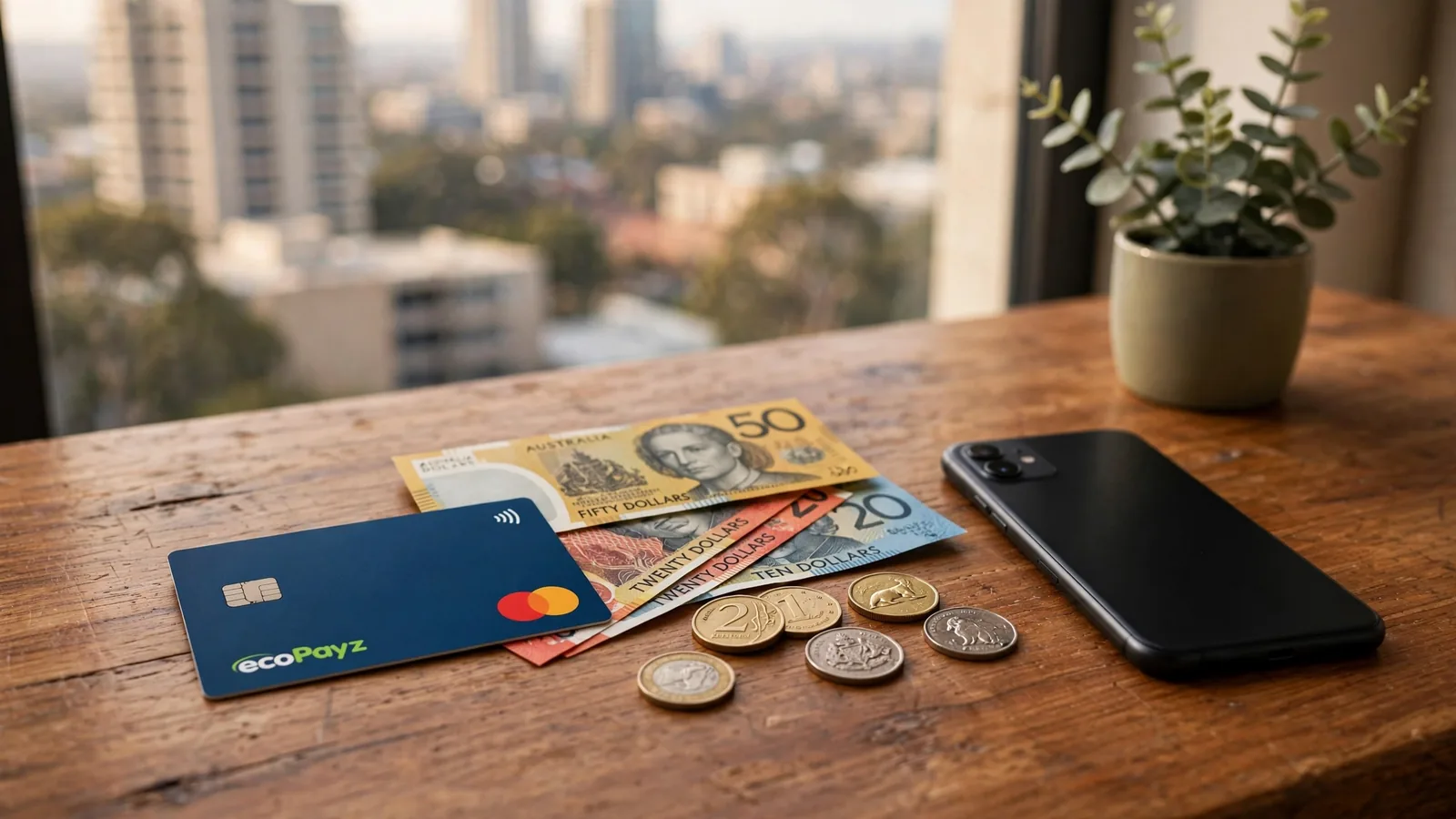
A practical look at funding offshore accounts with SOL and assessing fees, bonuses, cash-out terms and unresolved-balance risks.

Funding an offshore casino account from Australian dollars is generally a two-stage process: AUD is deposited with an Australian exchange and converted to SOL, then SOL is sent to the casino’s wallet. Most Solana casinos do not take AUD directly by bank transfer or credit card. The exchange is therefore the on-ramp, not an optional extra step in a direct AUD payment.
Swyftx, CoinSpot and Coinbase AU support AUD deposits by PayID or bank transfer. These are funding methods for the exchange account; they do not mean that the casino accepts PayID or bank transfers. After the AUD deposit reaches the exchange, it can be used to buy SOL. The purchased balance then has to be transferred to the deposit address supplied by the casino.
The route can be reduced to three checks:
That final check has financial weight. SOL transfers are irreversible: a transfer sent to the wrong address can result in permanent loss. An address copied incorrectly, or a payment sent through a network the recipient does not support, may not be recoverable. The deposit instructions should be checked on the casino account itself, and the asset and network selected on the exchange should match those instructions. A familiar label is not enough; the destination details need to agree.
Once the transfer has been submitted, the casino must recognise it and credit the account before the balance is available for play. A completed exchange withdrawal and a spendable casino balance are separate stages. If the account does not show the deposit, the useful records are the exchange withdrawal confirmation, the destination address used and the transaction reference. Those details help distinguish a transfer that has not left the exchange from one that has reached the destination but has not appeared in the casino balance.
KYC and anti-money-laundering requirements also apply to services converting SOL to AUD or AUD to SOL. That means the exchange on-ramp and off-ramp may require identity checks. The conversion is not necessarily anonymous simply because the later transfer uses a cryptocurrency wallet. Account details, payment records and identity information may be requested as part of the exchange’s compliance process.
The same route works in reverse when converting a casino balance back into AUD: SOL must be sent from the casino to a wallet or exchange account that can receive it, then sold for AUD and withdrawn through an available method. The receiving address must be checked just as carefully as the deposit address. An exchange account should be ready to receive the asset before a withdrawal is initiated; otherwise, the path back to AUD is incomplete.
A casino account’s deposit instructions should be read before funds are sent. They define which asset and network the platform accepts and provide the address used for the transfer. If the instructions are unclear or do not match the exchange’s withdrawal options, proceeding creates an avoidable risk of a payment that cannot be credited. No assumption should be made that every platform described as a casino on Solana accepts every Solana asset or wallet transfer.
Using a VPN can also expose the account balance to seizure or loss under an operator’s terms. It does not make a mismatched payment route safer, nor does it remove the need to follow the platform’s deposit instructions. The funding process depends on the exchange, the selected asset and the destination details—not on the wording of a casino’s promotional label.
This is a funding route, not a guarantee that an offshore operator will accept a transfer or credit it correctly. The practical control available before sending is to verify the asset, network and address, and to keep the exchange’s transaction record. Once SOL leaves the exchange, the transfer cannot be reversed by changing a casino account setting.
Choosing a Solana casino for Australia involves checking the available licensing information and practical details such as deposit minimums and payout methods. This list gives a concise reference to the facts provided for each operator.
Bizzo Casino
Bizzo Casino is listed with a Curacao Gaming Control Board license held by TechSolutions Group N.V.
Vegaz Casino
Vegaz Casino is listed with Curacao license OGL/2024/1335/0780. Its stated minimum deposit is EUR 20.
Neospin
Neospin is listed with Curacao Gaming Control Board license OGL/2023/176/0095, held by Hollycorn N.V.
Ricky Casino
Ricky Casino lists crypto payouts in under an hour and PayID payouts in 1–3 business days. The minimum deposit is A$20, or A$30 to qualify for the bonus.
7Bit Casino
7Bit Casino is listed as a Curacao-licensed casino operated by Dama N.V.
Kingmaker
Kingmaker lists crypto payouts at about 90 minutes and fiat payouts at 1–5 days. Its minimum deposit is A$30.
WinSpirit Casino
WinSpirit Casino is listed with Curacao eGaming license OGL/2024/923/0383, held by Antillephone N.V. Its minimum deposit is A$30.
Playfina Casino
Playfina Casino is listed as a Curacao eGaming operator under Hollycorn N.V. since 2017. Its minimum deposit is A$20–30, depending on the offer.
Golden Pokies
Golden Pokies is listed as a Curacao-licensed casino.
DragonSlots Casino
DragonSlots Casino is listed with a Curacao Gaming Authority license, with Jumpman Gaming Ltd named as the operator.
A useful comparison of Solana casino terms is not a league table built around a welcome offer. It separates the conditions that determine whether a balance can be withdrawn from the features that affect the value of play. Without comparable, disclosed terms, a “best” label says little about the likely cash-out.
Withdrawal handling. A comparison can record the operator’s stated processing window and whether withdrawals are handled automatically or manually. A specialist review reports windows ranging from 5–15 minutes for automated processing to as long as 72 hours for manual handling. Those are operator-side estimates, not a promise of receipt by a wallet: processing also depends on the casino’s internal handling and network congestion. The distinction matters because a fast network cannot make an operator approve a withdrawal faster.
The terms should also make clear whether a withdrawal can be paused for review, what information may be requested, and whether bonus conditions must be completed first. Larger withdrawals or bonus cash-outs may trigger KYC checks requiring identity documents. A comparison that records payout speed but omits withdrawal KYC describes only the easy case. It should state the operator’s published policy and whether the requirement can arise before funds are released.
Cash-out conditions. Before any deposit, the relevant comparison is the amount that can leave the account and the conditions attached to it. These include any withdrawal fee, minimum or maximum cash-out condition, and restrictions on winnings connected to a bonus. The terms should be checked before depositing, not after a balance has been built. A displayed casino balance is not necessarily an amount available for withdrawal.
The comparison should distinguish cash from bonus funds and state how bonus-related winnings become withdrawable. If a maximum cash-out cap applies, its effect belongs beside the advertised bonus value, not in fine print after it. A generous headline offer can have limited practical value if the cash-out conditions restrict the amount retained. The useful figure is the amount eligible to leave after every stated condition has been applied.
Bonus value. A specialist review describes effective bonus value as depending on playthrough, game contribution, time limits and maximum cash-out caps. Each condition changes the calculation. The nominal bonus amount alone does not capture how much betting is required, which games count toward that requirement, how long completion is allowed, or whether a cap limits the resulting withdrawal.
For comparison, the terms need to be assessed together rather than as separate promotional features. A lower playthrough requirement may still be less useful if eligible games contribute only partially or the deadline is restrictive. A higher headline amount may be worth less if a cash-out cap limits the proceeds. These are not interchangeable conditions; leaving one out can reverse the apparent order of two offers. Slot contribution rules and wagering arithmetic are separate questions, but a comparison should at least disclose the rules that determine whether bonus funds can become withdrawable.
Evidence behind a recommendation. Any recommended casino should have its licensing information, game RTP, provably fair tools and withdrawal KYC policy checked and disclosed. Licensing claims need to identify the issuing jurisdiction and what the claimed licence covers; a label without those details is not meaningful evidence. RTP information should be tied to the relevant games, while provably fair claims should explain which games and verification tools they apply to. A feature listed without scope cannot support a comparison.
The same standard applies to payment and withdrawal descriptions. Operator claims should be distinguished from independently reported terms, and any uncertainty or variation should be stated rather than converted into a categorical promise. A review should not infer that an operator will honour a withdrawal merely because its published process appears clear.
Commercial links also affect how a comparison should be read. Any partner link must be identified as affiliate or promotional content. That disclosure does not make the underlying terms more or less favourable; it tells the reader that the page may receive compensation if the link is used. Rankings and recommendations should not hide that relationship.
There is a separate market constraint behind any assessment of offshore casino services: the Interactive Gambling Act 2001 prohibits offshore operators from providing online casino games to Australian residents. Using an offshore site is not legally safe simply because individual players are not directly penalised. Nor does a comparison create Australian consumer protection. Offshore operators may withhold funds or close, leaving no recourse under Australian law. VPN use may also result in account seizure and loss of funds.
Finally, the payment route itself carries risks that a terms table cannot remove. SOL transfers are irreversible; sending funds to the wrong address can mean permanent loss. SOL price volatility can also reduce the AUD value of winnings between deposit and withdrawal. Those risks are distinct from a casino’s stated payout speed or bonus value, and should not be obscured by either.
Owning SOL is not the same legal question as using it to gamble. Australians may buy, hold and transfer the cryptocurrency. The point at which it is used at an offshore online casino brings the Interactive Gambling Act 2001 into play: the Act prohibits overseas operators from providing online casino services to people in Australia.
That prohibition covers casino-style services, rather than turning SOL itself into an unlawful asset. The form of payment does not change the nature of the service. A site accepting SOL is still an offshore operator if it offers online casino games to Australian residents; describing the account as crypto-based does not create an exemption.
The Act is directed at the operator, not the individual player. Australian players are not directly penalised under the Act simply for using an offshore casino. That distinction should not be mistaken for approval, a local licence or a guarantee that an account will remain accessible. The legal position is often described as a grey area for players, but the operator’s provision of casino services to people in Australia is prohibited. A lack of player prosecutions would not make that use legally safe.
Enforcement is visible in website access. The Australian Communications and Media Authority (ACMA) enforces the Act, including by blocking unlicensed offshore gambling websites. A blocked domain may stop loading from Australia, while a replacement address or a site that remains accessible does not establish that the operator is permitted to serve the market. Accessibility is a technical condition, not a legal status.
The framework is also not a conventional local licensing system for crypto casinos. A specialist review describes no specific Australian licensing framework for crypto-gambling operators as having materialised by mid-2026. That time-bound description should not be read as evidence that offshore sites are authorised: the prohibition on operators providing online casino services to Australians remains the relevant rule.
The Australian Communications and Media Authority (ACMA) enforces the Interactive Gambling Act 2001 by blocking unlicensed offshore gambling websites. Accessing a site via a replacement address does not establish that the operator is permitted to serve the market.
The practical consequence is a sharp division between the asset and the service. Holding or transferring SOL is lawful; using SOL as a stake at an offshore casino does not make the casino’s offer lawful in Australia. Nor does an offshore licence, if a platform claims to hold one, override the Australian prohibition. The legal status of the operator’s services and the Australian legality of owning the token are separate questions.
There is also a separate consumer-risk issue. Players using offshore Solana casinos have no protection under Australian law if an operator freezes an account or withholds winnings, and Australian authorities do not provide a local route to recover those funds. A VPN does not change the legal position; using one may lead to account seizure and loss of funds. In short, a site loading successfully is not evidence of regulatory approval, and the absence of direct player penalties is not a finding that offshore gambling is legally safe.
A bonus balance is not the same as withdrawable money. Winnings generated from bonus funds must be wagered with real money before they can be withdrawn. The cash-out calculation therefore depends not only on the stated wagering requirement, but also on which games count towards it and at what rate.
Slot play can make progress through a wagering condition faster than games with a lower contribution rate. Slots typically count at 100% of the qualifying bet, while blackjack and roulette may count at only 10–20%. If a bet is excluded or only partly counted, its full value does not reduce the remaining requirement. The balance shown in an account can therefore look spendable while the wagering counter advances more slowly than the amount staked.
The relevant figure is the contribution attached to the game, not simply the size of the bet. A slot bet that qualifies at 100% counts in full; a table-game bet with a 10% contribution counts as only a fraction of its stake. A player switching between game types may consequently accumulate very different qualifying turnover from the same amount wagered. The bonus terms determine which games qualify, so the game category alone is not enough to establish the result.
Free spins can add a separate layer. Their winnings may be placed in bonus funds rather than credited as cash, and a specialist review describes an offer in which those winnings carry a separate wagering requirement, such as 50x. That condition should not be assumed to match the requirement attached to the main bonus. If the spin winnings become restricted funds, they may need to be wagered again before withdrawal, even where the spins themselves have already been used.
The practical sequence is to identify what is credited, what must be wagered, and which games count. A displayed win from free spins is not necessarily the amount available to withdraw. If it is converted to bonus funds, the relevant requirement applies to that credited amount under the stated terms. A separate condition can also mean that completing one requirement does not complete the other.
Before depositing, the cash-out terms need to be read alongside the bonus description. In particular, the terms should specify whether free-spin winnings become bonus funds, whether those funds have a separate wagering condition, and how each game contributes. Larger withdrawals or bonus cash-outs may also prompt KYC checks requiring identity documents, so a balance meeting the wagering condition does not by itself establish that payment will be immediate.
For SOL users, the bonus calculation and the transfer are separate risks: SOL transfers are irreversible, and funds sent to the wrong address are permanently lost. A wagering condition cannot correct a mistaken transfer. The useful measure is therefore not the headline bonus or the slot win, but the amount that remains eligible for withdrawal after every applicable contribution and cash-out rule has been met.
A casino described as Solana-based may accept SOL, but that does not establish that it accepts every asset associated with the network. A specialist review reports that some platforms also allow deposits and play using USDC on Solana. That is a platform-specific payment option, not a feature that can be assumed across all casinos.
The distinction matters because SOL and USDC are separate tokens, even when both are transferred on Solana. A site’s payment instructions need to identify the accepted asset and network. A wallet balance in one token does not mean a deposit in another will be credited. SOL transfers are irreversible; funds sent to the wrong address or through an unsupported route can be permanently lost.
USDC support changes the payment unit, not the nature of the service. It does not establish that a casino is licensed, that its balance is protected, or that withdrawals will be processed on any particular schedule. Nor does the presence of a Solana wallet address prove that every token on the network is supported. The operator’s stated deposit terms are the relevant boundary.
An NFT label requires the same separation between description and function. Calling a site a Solana NFT casino does not, on its own, establish that NFTs can be deposited, used to play, earned as rewards or exchanged for a casino balance. Those are distinct mechanics, and a label cannot substitute for specific terms explaining what an NFT does and how value moves. Without such terms, the label says little about the payment options.
The practical comparison is therefore narrower than the branding suggests: which token is accepted, on which network, and whether the balance and withdrawal terms apply to that token. If a platform names SOL and USDC on Solana, that supports only those stated options. It does not justify assuming NFT utility or extending the claim to other assets.
There is also a separate Australian legal boundary. The Interactive Gambling Act 2001 prohibits offshore operators from providing online casino games to Australian residents. Holding or transferring SOL is legal, but that does not make using an offshore casino legally safe. The law targets operators rather than directly penalising individual players; that distinction is not consumer protection. Offshore operators have limited safeguards for Australian customers, and Australian authorities do not provide recourse if funds are withheld or a platform closes.
VPN use can add another risk: an operator may seize an account and funds if it treats the connection as a breach of its terms. Larger withdrawals or bonus cash-outs may also trigger KYC checks requiring identity documents. These conditions concern access to an account, not whether its deposits use SOL, USDC or an NFT label.
Any link that promotes an offshore casino should be clearly identified as affiliate or promotional content. The payment description, the marketing label and the legal position are separate facts; none should be used as a substitute for another.
Australian tax treatment separates gambling income from the cryptocurrency used to play. Recreational gambling winnings are generally not taxable. That broad treatment does not mean that a win paid in SOL, or a gain made while gambling with SOL, is automatically outside the tax system.
The Australian Taxation Office regards cryptocurrency as an asset for capital gains tax purposes. Accordingly, profits from gambling with SOL can attract capital gains tax even where the gambling activity itself is recreational. The relevant distinction is between the character of ordinary gambling winnings and the tax treatment of a gain involving a crypto asset. Treating the entire result as a tax-free gambling prize would overlook the asset dimension.
This can make a crypto casino outcome different from a cash gambling win. A player may have a gambling result and a separate tax consequence associated with SOL. The fact that SOL is used as the stake does not convert the cryptocurrency into ordinary cash for tax purposes, nor does the recreational nature of the activity remove the stated capital gains treatment.
Losses do not provide a routine offset against gains. Specialist tax commentary identifies a narrow exception: gambling losses may be offset against gains only where the player qualifies as a professional gambler. That classification has a high threshold. Occasional or recreational play should not be treated as sufficient by itself to establish professional status, and a losing session does not automatically cancel a capital gain.
The practical distinction is therefore material: recreational winnings are generally not taxed as gambling income, while profits from gambling with SOL fall within the ATO’s capital gains treatment of cryptocurrency. The professional-gambler exception is limited, not a general allowance for netting losses against gains.
For someone assessing a SOL casino result, the tax question cannot be answered solely by asking whether the activity was recreational. The cryptocurrency component matters as well. A positive outcome in SOL may therefore have a different tax treatment from an equivalent win received as ordinary money. Conversely, gambling losses cannot be assumed to reduce taxable gains unless the demanding professional-gambler condition is met.
This is a distinction of tax character, not a promise that every transaction produces the same result. The key points are the recreational status of the gambling, whether profits involve SOL, and whether professional-gambler status can genuinely be established. A casual player should not presume that losses are deductible simply because winnings involving cryptocurrency may have capital gains consequences.
Solana’s network can settle a transaction quickly, but that describes the blockchain, not the casino’s handling of a payment. A specialist review puts confirmation at about 400 milliseconds and reports that balances update immediately after confirmation. Those figures concern on-chain activity; they do not show how quickly an offshore operator will credit a deposit, approve a withdrawal or release a balance.
The distinction matters because a payment has separate stages. The network can record a transfer while the operator’s account system still has not reflected it. On withdrawal, the reverse applies: an operator may need to approve and send the payment before the network can confirm it. Solana’s speed therefore cannot be read as a promise of instant casino-side processing.
The same review reports an average Solana transaction fee of $0.00025 USD, effectively a near-zero network cost for an individual transfer. That fee is separate from any charge an operator may impose. It also does not remove the financial risk of sending funds: SOL transfers are irreversible, and a transfer to the wrong address can result in permanent loss. A low fee makes a mistaken transfer no less final.
These network characteristics apply whether a casino labels its offering as a Solana casino or promotes dice games built around SOL. The label does not change the transaction mechanics, and it does not establish that the operator processes payments at network speed. Nor does fast settlement make an offshore casino lawful for Australian residents: the Interactive Gambling Act 2001 prohibits operators from providing online casino games to people in Australia.
Network performance is only one part of the transaction. The quoted fee is a blockchain cost, not a measure of the total cost or the time required for an account payment. The operator’s internal steps remain outside Solana’s control, as does congestion on the network. A quick confirmation should therefore be treated as evidence that a transfer reached the chain, not as evidence that a casino has approved or completed the associated account action.
Using a VPN may result in account seizure and loss of funds. That risk is not offset by fast confirmations or near-zero fees: network efficiency says nothing about whether an offshore operator will honour a balance or provide recourse if it does not.
A wagering multiplier converts a bonus into required betting volume. The calculation is straightforward: multiply the eligible bonus amount by the stated requirement. The result is turnover, not a deposit to be returned and not a guaranteed loss limit.
A specialist review describes a 40x requirement on a 5 SOL bonus. That condition calls for 200 SOL in bets before withdrawal. The 5 SOL is the bonus basis; the 200 SOL is the amount wagered across qualifying play. Confusing the two makes the offer look smaller than its cash-out condition.
Another specialist review reports a 35x requirement applied to the bonus only. “Bonus only” matters: the multiplier is applied to the bonus amount, rather than to the combined deposit and bonus. The terms must state which balance is used, or the displayed multiplier cannot be translated into a reliable turnover figure.
Turnover carries a cost because games have a house edge. At a 4% house edge, 200 SOL of betting has an expected cost of 8 SOL: 200 × 0.04. Against a 5 SOL bonus, that simplified expectation is 3 SOL more than the bonus value. On that arithmetic, the bonus is effectively negative before other restrictions are considered.
This is an expected-value calculation, not a prediction of an individual session. Outcomes vary, and the calculation assumes the stated house edge applies across the qualifying bets. Game eligibility, contribution rules, time limits and cash-out caps can make the actual value lower; they do not turn required turnover into cash.
The cash-out condition should therefore be assessed before a deposit, not after a win. A large multiplier can require enough turnover for the expected game cost to exceed the bonus itself. A nominal bonus amount says little without its multiplier and the balance to which that multiplier applies.
This arithmetic does not make offshore play legally safe. The Interactive Gambling Act 2001 prohibits offshore operators from providing online casino games to Australian residents; the fact that individual players are not directly penalised does not remove that prohibition. Using a VPN can also expose an account and its funds to seizure.
A specialist review places minimum SOL deposits in the 0.01–0.1 SOL range, equivalent to approximately AUD$2.80–$28 at April 2026 prices. These are reported figures, not a universal schedule: each offshore operator sets its own threshold, and the amount required can change with SOL’s AUD price. The minimum is only the entry point. It does not indicate what can be withdrawn or what the balance will be worth when converted back to Australian dollars.
Withdrawal costs also need to be separated into two categories. A specialist review reports that some casinos impose their own withdrawal charge, ranging from 0.1% to 1% of the amount withdrawn. That deduction is controlled by the operator. A Solana network fee, by contrast, is a transaction cost for sending SOL on-chain. A near-zero network fee does not cancel an operator’s charge, and an operator fee is not evidence of a higher network cost.
The larger variable may be the token’s exchange value. A balance can remain unchanged in SOL while its AUD value falls between deposit and cash-out. Conversely, a price increase can raise the converted value; neither outcome is guaranteed. This market risk is distinct from both the network fee and any casino deduction, so a displayed SOL balance alone does not establish the final amount received in AUD.
SOL transfers are irreversible. If funds are sent to the wrong address, they may be lost permanently. Offshore casinos are prohibited under the Interactive Gambling Act 2001 from providing online casino games to Australian residents, and the absence of a player prosecution does not make their use legally safe. Australian players have no legal protection under Australian law if an operator withholds funds or closes. VPN use may lead to account seizure and loss of funds.
Cash-out terms should be read before any deposit, including the operator’s fee, conversion method, minimum withdrawal and applicable KYC checks. Larger withdrawals or bonus cash-outs may require ID verification. A low deposit threshold cannot compensate for a costly or restricted exit. Any partner links accompanying a comparison must be clearly labelled as affiliate or promotional content; a referral link is not evidence that an operator’s payment terms are favourable.
A Solana transaction can settle quickly without making a casino payout quick. A specialist review reports that native SOL withdrawals on competent platforms may take 30–60 seconds to process, but that figure concerns the transfer, not the operator’s approval of it. Casino-side checks and queues create a separate delay: stated processing times range from 5–15 minutes for automated handling to as long as 72 hours where withdrawals are reviewed manually. Network congestion can add further uncertainty.
A pending balance is therefore not equivalent to SOL in a wallet. Larger withdrawals or bonus cash-outs may trigger KYC checks, including a request for identification. The operator’s cash-out rules and verification conditions should be read before depositing; a delay after a win is a poor time to discover them. Using a VPN may also lead to account seizure and loss of funds.
The more serious exposure is an unresolved balance. Offshore operators are prohibited under the Interactive Gambling Act 2001 from providing online casino games to Australian residents. The fact that individual players are not directly penalised does not make use legally safe. If an offshore casino freezes an account, withholds winnings or closes, Australian players have no legal protection under Australian law for recovering those funds and no recourse through Australian authorities.
SOL transfers are irreversible. If a payout is sent to the wrong address, the funds are permanently lost; a fast network cannot reverse the mistake. That is distinct from an operator refusing to release a balance, where the delay is on the casino’s side and the practical recovery options in Australia are limited. A displayed payout estimate is not a guarantee of settlement, and the unresolved balance remains exposed until it reaches a wallet under the player’s control.
The typical minimum deposit is 0.01–0.1 SOL, and the average Solana transaction fee is about US$0.00025. Transfers confirm in about 400 milliseconds, though the casino must still credit the deposit before the balance is ready to play.
Minimum deposits typically range from 0.01 to 0.1 SOL, approximately AUD$2.80–$28 at April 2026 prices.
Deposit AUD into an Australian exchange such as Swyftx, CoinSpot or Coinbase AU using an available method such as PayID or bank transfer, then buy SOL and send it to the casino’s deposit address. Check that the asset, network and address match the casino’s instructions before sending; SOL transfers are irreversible.
For a deposit, buy SOL with AUD on an exchange and send it to the casino’s stated address using the supported asset and network. To withdraw to AUD, send SOL from the casino to a wallet or exchange account that can receive it, sell it for AUD, then withdraw using an available method; verify the receiving address first.
Australians can legally buy, hold and transfer SOL, but using offshore online casinos is a legal grey area under the Interactive Gambling Act 2001, which prohibits overseas operators from offering online casino services to Australian residents. The Act targets operators rather than players, but Australians using offshore casinos have no legal protection if an account is frozen or winnings are withheld.
Solana transactions confirm in about 400 milliseconds, and balances update immediately once recognised. Withdrawals can take longer because casino processing ranges from 5–15 minutes for automated handling to as long as 72 hours for manual handling.
Native SOL withdrawals typically process within 30–60 seconds on competent platforms, but casino-side handling can take 5–15 minutes with automated processing or up to 72 hours with manual processing. Speed also depends on the operator’s internal handling and network congestion.
Buy SOL using AUD on an Australian exchange, then send it to the deposit address shown in your casino account. Confirm that the selected asset and network match the casino’s instructions and check the address carefully, because SOL transfers cannot be reversed.
Prepared by the SpinsUP Casino editorial staff.